How Russia smuggled over €600 mln out of the country using plastic manufacturing machines: the story of the plastic laundromat
July 8, 2022
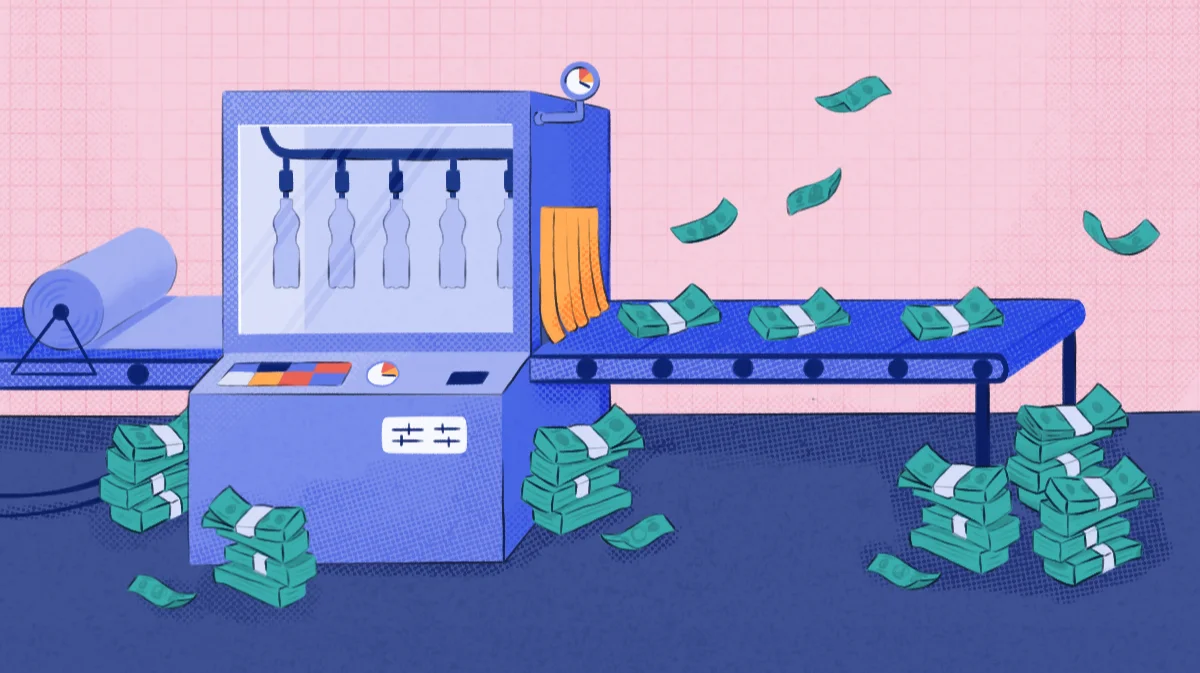
Illustration by Alesya Borisova/Novaya Gazeta. Europe
Billions of rubles were smuggled out of Russia using a unique money laundering scheme: its participants registered bills of sale abroad and tax-free import documents that said the goods were transported to Russia. In reality, the goods never crossed the border, or their price was many times higher than the actual cost. Novaya Gazeta. Europe is publishing an investigation carried out in cooperation with Transparency International Russia, Transparency International UK, Transparency International Czech Republic, Meduza, The Insider and Eesti Päevaleht about the new “laundromat” that involves at least 28 Russian banks, 130 companies from different states and many high-ranking officials.
We studied customs data on foreign trade operations to find that in the period from 2014 to 2016, over 41 billion rubles (over €600 mln) could have been withdrawn from Russia via dubious plastic manufacturing equipment deals. The prices of injection moulding machines were dozens or even hundreds of times higher than the actual cost. We have managed to detect 124 dubious deals. Transparency International Russia learned that this money laundering scheme was used by people with ties to Russian businessman Yevgeny Prigozhin, banker Sergey Kononov, sports manager Andrey Safronov, general-mayor of justice Igor Komissarov, former Russian MP Natalya Burykina, disgraced banker Roman Stroykov and many others.
Tax-free import and purchase documents are used to legally transfer money from a Russian company to a foreign enterprise, avoiding extra fees and taxes. This is a common money laundering method around the world, also known as Trade Based Money Laundering, or TBML. Fake trade deals are used to legalise illicitly obtained funds.
An expert in foreign economic activity who wished to remain anonymous told Transparency International Russia about dubious deals on the purchase of injection moulding machines used to manufacture plastic products. In Russia, the import of these machines with specific characteristics is tax-free, which created the conditions for illegally transferring funds abroad.
A plastic empire
In 2019, a court in St. Petersburg sentenced former head of a little-known Saint Petersburg Investment Construction Company Aleksandr Skirdov, 69, to a five-year suspended sentence. According to the case materials, back in 2016-2017, the company transferred money to an Estonian firm Grizpol allegedly for the purchase of several Italian injection moulding machines. In reality, two Chinese-made machines crossed the border several times instead of the Italian equipment.
This deal to the tune of €7.3 mln according to the falsified customs declarations was approved by Bank Saint Petersburg. Sergey Serdyukov, the son of former Russian Defence Minister Anatoly Serdyukov, owns a 5.8% share in the bank, while Sergey Matviyenko, the son of Russian senate speaker Valentina Matviyenko, owns 2.7%.
A transnational leader
The largest sums that left Russia through the plastic money laundering scheme were recorded in March-April 2015. Over 3 billion rubles (over €46 mln) were paid for four injection moulding machines made in the late 1990s. The price of these ranges from €7,000 to €30,000. There is no way that these machines could cost billions of rubles (dozens of millions of euros).
Three Russian firms — BusinessCapital, TradeMarket and NordTech — paid these insane sums for the injection moulding machines. All of them have been liquidated by now. The first two companies were registered in Moscow on the same day, 9 July 2014, while NordTech was registered a year before that. The companies were located in residential buildings on the outskirts of Moscow and St. Petersburg in the so-called mass registration locations: hundreds of firms were registered there. The majority of them have since been liquidated, and their formal owners were simultaneously the owners of dozens of other companies.
For example, BusinessCapital was owned by 67-year-old Nina Lyubimova from Podolsk, a town in the Moscow region. She was also the owner or co-owner of 19 more companies, the majority of which have shut down by now. Her son Dmitry Lyubimov, who formally resides in Lyubimova’s neighbouring apartment in Podolsk, was deemed a mass owner in 2017 by the Federal Tax Service of Russia. The Russian Federal Bailiffs Service points out that Lyubimov has a pending debt of 32 mln rubles (over €540,000). Promtorginvest, a company headed by Lyubimov, owed 325 mln rubles (over €5.3 mln)to MAST-Bank. After the bank went bankrupt, Russia’s Deposit Insurance Agency sold this debt at an auction with Lyubimov’s approval.
These Russian companies transferred money for the injection moulding machines to Latvia’s SIA Veikals 512 and the UK’s Bringston Corporation LP, whose beneficiaries were not shown. Both companies were mentioned in the so-called laundromat investigations into a network of banks and companies involved in money laundering schemes. SIA Veikals 512 was founded by Latvian national Valentin Voytenko in 2014, and two months later, the company’s management was transferred to a Russian citizen Aleksandr Vasilyev. By the time the injection moulding machines were sold to Russia, the company was already owned by a British company Exportum LP. Aleksandr Vasilyev was a member of the company’s board. SIA Veikals 512 changed its registration several times, moving from one apartment in a residential building to another.
Exportum LP was registered in Scotland by two offshore firms: Corporate Management LTD and Capital Consortium LTD. Both companies founded numerous firms in England, with over 4,000 companies registered under the same address. The UK’s Bringston Corporation LP was founded by two Seychelles-based companies Lancaster Management Association LTD and AFK Business Management LTD back in 2012.
These offshore companies also founded the firm owned by the wife of Andriy Kravets, who used to serve as head of former Ukrainian leader Viktor Yanukovich’s presidential office. They also own numerous companies in the UK. In July 2019, Bringston Corporation LP switched owners to other offshore firms: Anglo Holding International LTD and Inter Holding LTD).
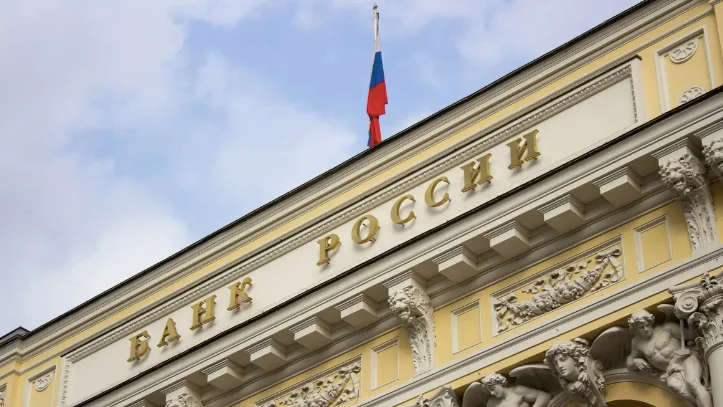
In April 2015, Russia’s Central Bank suspended the bank’s license for “carrying out suspicious operations of its clients on transferring large sums of money abroad.”
After the bank had lost its license and a temporary management team had taken the reins, it was discovered that the “capital hole” in the bank came up to 2.56 bln rubles (over €39 mln). Russia’s Deposit Insurance Agency noted that for two years until its license was revoked, the bank had submitted falsified reports to the Bank of Russia on its financial situation despite the fact that it had been essentially bankrupt all this time.
***
The money laundering schэрррннпрнпррeme through falsified trade deals had existed for several years, despite the fact that these deals should have been controlled by several law enforcement and economic agencies. It is hard to imagine that the purchase of tax-free goods for large sums, the majority of which went through the same customs department, had been simply slipping through the officials’ fingers for all those years. Perhaps it all comes down to the beneficiaries of the deals and the banks themselves. You can read more about it in the Russian-language version of this article.