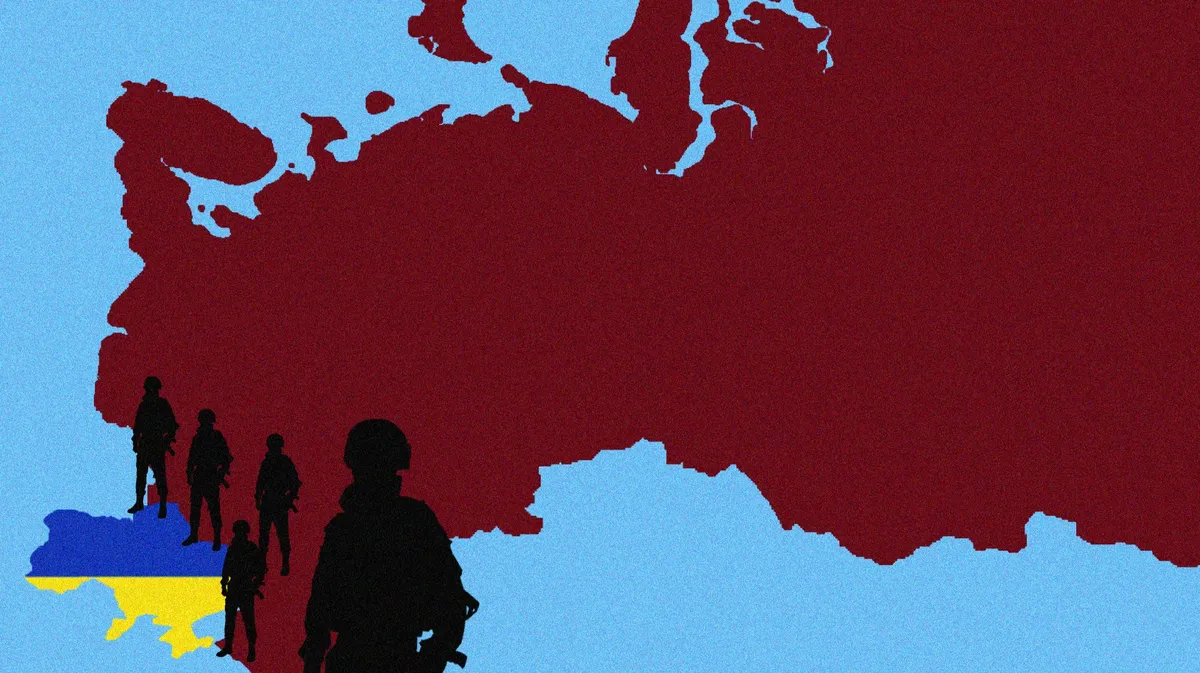
Russian officials and propaganda thought their army was the second-best in the world. Other world leaders sometimes agreed. In 2016, Barack Obama said the Russian army was second only to that of the US. Even Volodymyr Zelensky said in his address on the anniversary of the war that Ukraine has resisted the “world’s second army”. But this phrase became a meme several months after the invasion, and the actions of the Russian army in Ukraine raise questions: why did it start failing on the front almost immediately and why does it continue giving up its positions?
This is our new feature where we give bite-sized explanations to what is going on right now. War experts Leonid Nersisyan and Georgy Aleksandrov helped us make this piece.
Russian intel proved its inefficiency
In February 2022, when Russia was gathering troops on the Ukrainian border, Conflict Intelligence Team experts said that this number of personnel and equipment would suffice to capture large cities. Different estimates put the total number of troops at the border at 150,000-190,000. That included 90,000 soldiers and 30,000 National Guard officers. The rest were the militias of the so-called “people’s republics” of Donetsk and Luhansk. Though its army exceeded Ukrainian forces in number, Russia was poorly prepared for the invasion. Firstly, the Russian army used obsolete maps from the 1970s. Soviet intelligence had indeed made detailed descriptions of many Ukrainian cities, marking military facilities, but 50 years later these maps are obsolete. Many factories have closed down or have been turned into civilian facilities. For example, Russia shelled the Zhuliany airport in Kyiv because it used to be a military warehouse.
Secondly, Russian intel was wrong in its assessment of pro-Russian views in Ukraine. The army seems to truly have expected Ukrainians to greet it with flowers. Guardsmen entered cities armed only with truncheons and shields, and regular soldiers were poorly-equipped, instead carrying parade uniforms. This is proved not only by photos published by the Ukrainian army. According to Mediazona and the BBC Russian Service, who are keeping track of killed Russian troops, soldiers of orchestra regiments were among those killed in the first days of war.
The blitzkrieg failed
Russia’s army entered Ukraine: elite regiments of mostly contract servicemen marched along the highways to large cities, attempting to capture them. The media expected Kyiv to be captured soon. But Russia’s convoys stretched out, the 190,000 troops became dispersed, facilitating artillery attacks that rained fire on the advancing army. Moreover, Ukraine attacked supply lines, leaving Russian soldiers without fuel and reinforcements as early as in the first month of the war. Russians lost fewer tanks to Ukrainian attacks than to lack of fuel, which forced troops to leave tanks behind.
At first, the Russian army was somewhat successful on its southern front. Experts say it is because Russia’s southern military district is generally considered better-prepared than others, and there was indeed some pro-Russian sentiment in Ukrainian settlements on the border with Crimea. A huge mistake of the Russian army was being unclear from the start of the war as to who exactly is commanding the invasion. A modern army requires decision-making and communication between different army branches on a local level.
At first, the troops weren’t even assigned call signs. Neighbouring regiments could not contact each other, and officers used cell phones instead of radios, making Russian army positions easy game for Ukrainian artillery. Generals visiting the front line perished rapidly, and orders were given from various command units located inside Russia.
Irrelevant instructions led to Russian tanks attempting to storm Vuhledar through minefields or losing over 100 vehicles and crews while trying to cross a river next to Bilohorivka.
Constantly shrinking combat capacity
It became clear already at the start that the plan to swiftly capture Ukrainian cities failed, but Russia did not do anything except carry out heavy shelling, wasting a fair share of missiles. Having lost a significant part of the army, Russia involved anything it could to help things along. For a long time, the authorities refused to declare a mobilisation, but were forced to do so as part of a change of tactic: going into a prolonged war and storming fortifications.
Several PMCs were sent to the frontline. They even had to use soldiers that were guarding the country’s borders: for example, the 18th machine gun-artillery division, which was guarding the Kuril Islands, and soldiers from the base in Gyumri. But in spite of the increase in quantity, the quality grew poorer and poorer. Given the operations that we’ve seen, experts say the Russian officers’ level of expertise is quite doubtful. Ukrainian soldiers, on the other hand, have plenty of combat experience, since the war in Ukraine has been going on for 8 years.
Of all the PMCs fighting in Ukraine, only Wagner has played a significant role in this war. From the outset, they were better trained and supplied than the regular Russian army.
But eventually Wagner started recruiting prisoners due to manpower shortage. They stormed Ukrainian fortifications, which requires a large number of soldiers. Of course, prisoners aren’t highly motivated or elite fighters, but they enabled Wagner to storm fortifications without taking heed of the losses.
Loss of advantage in weapon power
Heavy losses, supply issues, and failures to gain a foothold in large cities forced the Russian army to switch from strategic goals to tactical ones. Though the Russian military doctrine says that modern wars end quickly, the army was forced to go into a protracted war. The goal now isn’t to capture as much land as possible, but only to seize the regions of Donetsk and Luhansk. But even after this transformation, the Russian war tactic remains overly straightforward: it resorts to mass firepower. This worked in Bakhmut and Mariupol because, at the time, the Russian army could afford to use exponentially more artillery ammunition per day than the Ukrainian army.
But even Soviet missile supplies aren’t endless, and that advantage began dissipating with time. Besides, Ukraine has acquired high-precision weapons.
Western supplies not only help Ukraine shoot down cruise missiles, but increase chances of destroying ballistic missiles. Recent deliveries of the latest Patriot modifications aim at countering ballistic missiles specifically. Ukraine’s advantage in weaponry continues to grow. For instance, the rockets in the American HIMARS launchers are satellite-guided, a feature absent in Russian rocket launchers. The Ukrainian use of drones combined with satellite imagery provided by Western intelligence services has made Ukrainian shelling more efficient. Weapons shortages have even forced Russia to unfreeze T-54 and T-55 tanks produced back in the 50s. Experts believe the only reason to use them is to create an illusion of the presence of military vehicles in the field.
Inefficient aviation
Another Russian mistake is lousy deployment of the air force. Before the invasion, experts emphasised the notable advantage of the Russian air force over the Ukrainian one. But it failed to crush Ukraine’s air defences, meaning Russia’s air force cannot launch massive attacks, especially against inland targets. Pretty much the only thing it does is support the troops on the front line. Russia has Su-34 and Su-24 aircraft, which still use FAB-500 and FAB-250 bombs. These bombs are unguided and over 50 years old. Russia already made the mistake of invading without proper air support before. Back in Afghanistan, this weakened Soviet forces.
Moreover, once Ukraine receives F-16 BC fighters, Russia will have issues even with the limited frontline operations that it is conducting now. An F-16 can carry out high-precision attacks and intercept cruise missiles. This can make Ukraine’s airspace practically impossible to penetrate.
In conclusion
Russian intel failed its mission. It used obsolete data and either misjudged the sentiment in Ukraine or deliberately gave information that the Russian authorities wanted to hear. This was why the Russian army was unprepared for a fully-fledged war: it didn’t have enough soldiers, while the plan to seize large cities led to the most capable contracted troops being destroyed.
After the first failure, Russia postponed decisions for too long, only declaring mobilisation once the Kharkiv front collapsed. The mobilisation itself was hurried and inefficient.
The Russian army’s organisation was also a hindrance. Even after years of modernisation and increasing the defence budget, Russia continues making overly centralised decisions, while its actions contradict its own doctrine.
Since Russian forces left Kherson, they haven’t taken a single settlement except for Bakhmut. Since spring, the front line has only advanced a couple of miles. Ukraine has now gathered its strength and can launch a counteroffensive using Western supplies and intel.