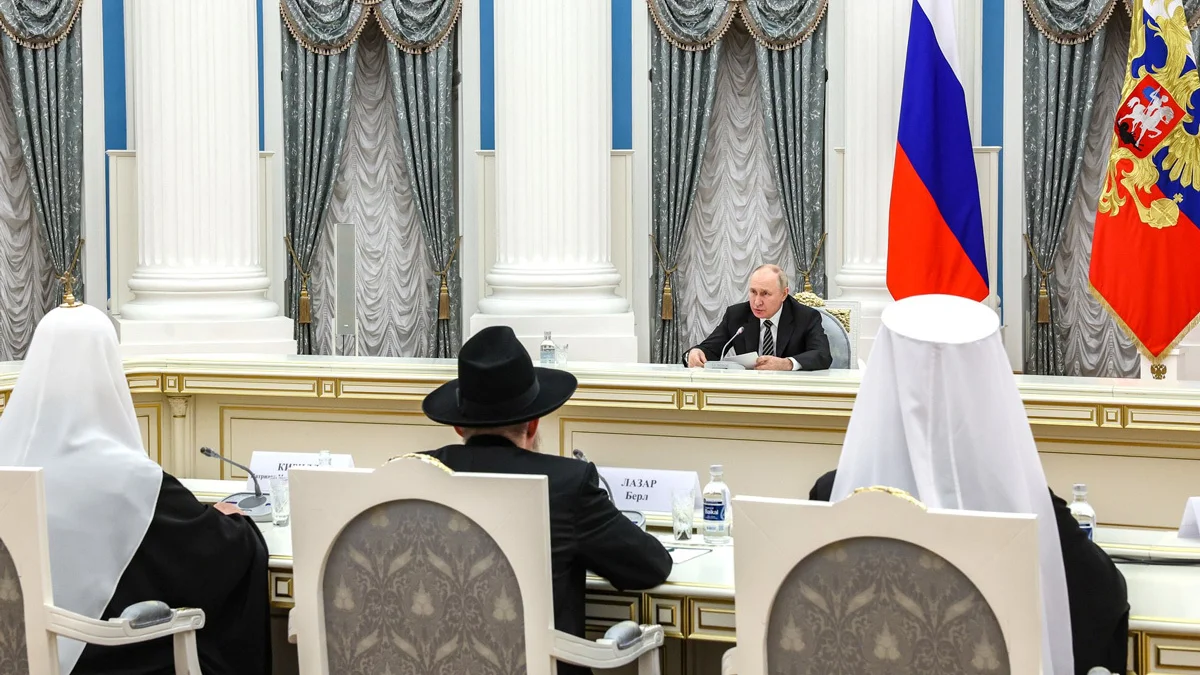
Having assured Russian President Vladimir Putin last week that Russia was immune to religious conflict, the country’s Kremlin-appointed religious leaders have been left flailing and uncertain how to respond to the anti-Semitic riots that broke out in the Russian North Caucasus on Sunday.
Last Wednesday, Putin hosted a meeting with the leaders of Russia’s so-called “traditional” religions — including Orthodoxy, Judaism, and Islam — who all assured him that anti-Semitism and Islamophobia weren’t significant issues in contemporary Russia and that escalation in the Israel-Gaza war posed no threat to Russia’s stability.

But just four days later an angry mob overran the airport in Makhachkala, the capital of the Muslim-majority republic of Dagestan in southern Russia, looking for Jews and “refugees from Israel”.

Anti-Semitic hate crimes were reported elsewhere in the Russian Caucasus last week as well. A construction site for a Jewish Cultural Centre was set on fire in the capital of Kabardino-Balkaria, while in the Dagestani city of Khasavyurt, people attempted to set a hotel on fire due to unconfirmed reports that Jews were staying there.

Patriarch Kirill responded to the Makhachkala Airport pogrom on Monday by acknowledging an “attempt to sow division between Russia’s Muslims and Jews” and claiming the source of the problem must have been external.

Russia’s Grand Mufti, Talgat Tadzhuddin, has kept quiet about the Makhachkala pogrom, issuing a vague statement on the situation in the Middle East and expressing his “outrage over the cruelty unleashed during this conflict” following a meeting with Vladimir Putin and other religious leaders on 25 October. His younger rival, Moscow-based Mufti Rawil Gaynetdin, signed a long statement by the Spiritual Directorate of Russian Muslims, admitting that the conflict in the Middle East had spread to Russia too.

During Sunday’s storming of Makhachkala Airport, Dagestan’s Mufti Akhmad Abdulayev called on the rioters to end the violence and leave the airport. He even pandered to the crowd’s anti-Semitism by promising to negotiate with local authorities to prevent a flight from Israel landing in Dagestan — the ostensible cause of riot.

However, nobody heeded Abdulayev’s words, and the mob was eventually dispersed a few hours later, in traditional Russian fashion, by special forces and the National Guard.

According to the 2021 census, just over 80,000 Jews live in Russia, while just 700 Jewish families live in Dagestan, the Federation of Jewish Communities of Russia (FJCR) says.

“People in the community are scared”, says Ovadia Sakovart, who represents Russia’s Chief Rabbinate in Dagestan. “They call me [for advice], but I don’t know what to say to them … It’s unclear where we can escape to.”

FJCR President Alexander Boroda released a statement on Monday in which he described incidents of open aggression towards Russian Jews and accused the authorities in Dagestan of being woefully unprepared to handle the unrest. He also called upon the federal government to punish those who instigated and took part in the riot “to the fullest extent of the law”.

But Boroda also censured the Russian government for stoking the flames of anti-Semitism with what he said was a pro-Palestinian bias in state media reporting that led the audience towards “radical viewpoints”.

The Kremlin’s indiscriminate use of terms such as “fascism”, “Ukrainian Nazism”, “Zionism”, and “International Jewry” in its barrage of propaganda aimed at justifying its ongoing war in Ukraine has only served to confuse the population, and it appears to have to way of reining in the anti-Semitisim it has itself been stoking for so long.

The distinctions between Putin’s regime and German National Socialism of the 1930s are becoming more and more difficult to see, with the result that there may be no easy way to prevent the rise of anti-Semitism in Russia today. There may be many more pogroms to come.

Поделиться
Темы
More stories
Как хотят наказывать за «отрицание геноцида советского народа»

Как хотят наказывать за «отрицание геноцида советского народа»

«Новая-Европа» разбирается в новом законопроекте, жертвами которого могут стать журналисты, историки и учителя
Джей Ди Вэнс едет на Южный Кавказ

Джей Ди Вэнс едет на Южный Кавказ

Каковы интересы Америки и какие новые геополитические смыслы обретает регион?
Маменькин сынок

Маменькин сынок

История «сибирского потрошителя» Александра Спесивцева
Разведка в Абу-Даби

Разведка в Абу-Даби

Кто такой Игорь Костюков — начальник ГРУ, возглавивший российскую делегацию на переговорах по Украине
Друзьям — деньги, остальным — закон

Друзьям — деньги, остальным — закон

Кто получает путинские гранты: от больницы РПЦ до антивоенных активистов
Три миллиона файлов по делу Эпштейна

Три миллиона файлов по делу Эпштейна

Трамп и другие контакты: что удалось обнаружить в новом и, возможно, последнем крупном массиве документов?

Поймай меня, если сможешь

Поймай меня, если сможешь

«Марти Великолепный» с Тимоти Шаламе — один из лучших фильмов сезона, рассказывающий историю об игроке в пинг-понг как криминально-авантюрную сагу
«Отношение к ним в Европе жестче, чем в первый год войны»

«Отношение к ним в Европе жестче, чем в первый год войны»

Что сейчас происходит с российскими дезертирами?
Что известно о ПНИ Прокопьевска, где из-за вспышки гриппа умерли девять человек

Что известно о ПНИ Прокопьевска, где из-за вспышки гриппа умерли девять человек

Сотрудники там жаловались на условия содержания пациентов: холод, испорченную еду и отсутствие лекарств
Readers' choice
Most popular articles from the last two weeks 20–3 февраля