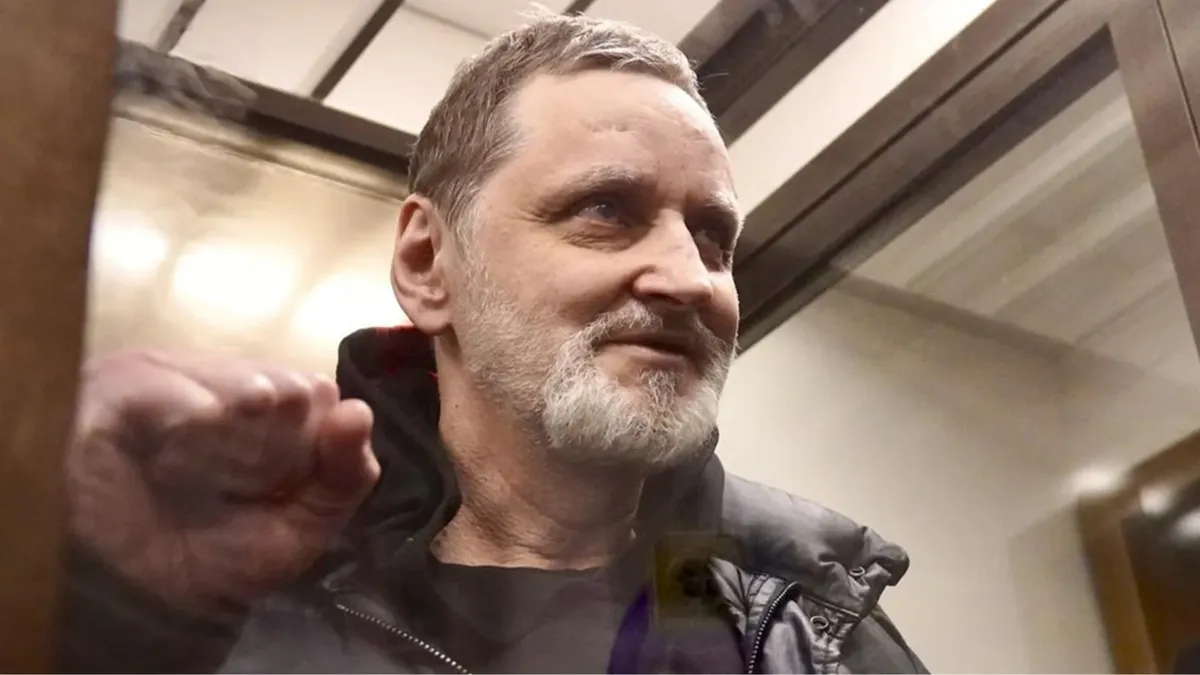
“If someone had told me in the late 80s or early 90s that there would be political prisoners in Russia again, and that they would get longer sentences for online comments than for committing murder, I would have told you you were mad,” says Alexander Nesterenko, a Russian academic currently in custody for including Ukrainian songs on an online playlist.

Nesterenko, who worked as an associate philosophy professor at Moscow’s prestigious Bauman School, has spent over a year in a pretrial detention centre awaiting sentencing after he was convicted on two counts of extremism. The prosecutors assigned to his case have requested he receive a four-year prison term.

The basis for the charge against him was a playlist he had made on popular Russian social media platform VK, which included several Ukrainian songs.

When Nesterenko was first detained on 3 September 2024, he was an active member of the liberal opposition party Yabloko who had twice run in Moscow’s municipal elections himself. Though he was initially released, he was re-arrested two days later and charged with “inciting hatred or enmity with the threat of violence”.

It emerged during the investigation that the basis for the charge against him was a playlist he had made on popular Russian social media platform VK, which included several Ukrainian songs. According to investigators, Nesterenko incited hatred with these songs.

Nesterenko’s status on VK is Ukraine’s national anthem. That alone would have been enough to incur the wrath of the authorities even without the other Ukrainian songs. From his cell, Nesterenko corresponded with Novaya Gazeta Baltic using the Russian prison service’s postal system.

*

“There was no choice. I couldn’t stay silent,” writes the 62-year-old Nesterenko, a member of the generation of Russians whose youth coincided with the late-1980s perestroika era. In that new spirit of freedom, and with the opening of the archives and the publication of previously banned literature, many young intellectuals believed that a return to the past was out of the question, and that no Russian would ever have to experience what the Soviet people had been forced to endure under Stalin.

Nesterenko explained that it was easier for him to challenge the authorities than for many others, as he had accumulated no wealth that could be confiscated. In 2023, he married Irina, a school teacher he met at a dance club. The couple have different views on life — she is deeply religious and had for many years worked in an Orthodox school, while he was a liberal, a critical thinker, and supported Yabloko, the last remaining legal opposition party in Russia.

Irina did once ask her husband if it was dangerous to put the Ukrainian national anthem as his status on social media, but he did not answer.

“The fact that students inform on their teachers was not a surprise after 20 years of working at the university,” Nesterenko wrote from prison. “That happened regularly, but when the war started, the accusations became political.”

“We didn’t talk much about politics either. I tried sometimes, but he either said nothing or just laughed it off,” says Irina. “Before my husband was arrested, I didn’t even know people could be arrested just for their views and opinions. So I wasn’t afraid back then. If a person is smart, adult, educated, then he knows what he’s doing.”

Nowadays Irina enjoys the support of her husband’s friends, including many of his former students who have become friends with their old lecturer since graduating. That said, Nesterenko’s current woes are due to some of his erstwhile students who collectively informed on him. One of them, Timofey Yudaev, was summoned to testify on their behalf at Nestorenko’s trial.

When asked by the prosecutor whether Nesterenko had brought up the “special military operation” in his lectures, Yudaev replied that he hadn’t done so directly, but that he and his classmates had subsequently found Nesterenko’s VK page, where they discovered audio and video recordings “in support of Ukraine”.

Chorus of disapproval
читайте также

Chorus of disapproval

Young Russians have responded to the arrest of singer Naoko with protest videos that are going viral on TikTok

Nesterenko, incidentally, didn’t recognise the student who testified against him, and told the court that he was seeing Yudaev for the first time. When Nesterenko asked him where his philosophy lectures had been held, Yudaev was unable to answer.

It appears that Yudaev was far more loquacious before he had to come face to face with Nesterenko in court. While the investigation was ongoing, he said that Nesterenko’s students began looking their lecturer up online after he called the war in Ukraine illegal and meaningless in front of some 20 people, and even “spoke indirectly about supporting Navalny and Ukraine”.

In his closing statement to the court, Nesterenko said that if he was guilty of anything, then it was not having been among those who were the first to be imprisoned by the Russian authorities for their beliefs.

“The fact that students inform on their teachers was not a surprise after 20 years of working at the university,” Nesterenko wrote from prison. “That happened regularly, but when the war started, the accusations became political: ‘He’s liberal and against the war’.”

A single hate speech charge was insufficient for the prosecutors, it turned out. In the summer, shortly before his trial began, Nesterenko was charged with an additional criminal offence: making “public calls for extremist activities”.

Ivan Seregin, a counterterrorism operative, also testified against Nesternko in court, saying that while monitoring him, he had come across Nesterenko’s social media accounts and observed his use of “Ukrainian nationalist propaganda”.

A third witness for the prosecution was originally due to appear in court, but, according to the prosecutor, had left Moscow to fight in Ukraine by the time the trial began. Who this mysterious third witness was and what role he played in the criminal case against Nesterenko remains a mystery.

Not only does Nesterenko say he has no regrets about what has happened, he even describes himself as grateful for the opportunity the case has afforded him to start life afresh, test himself and gain new experiences, all the while remaining true to his beliefs.

“Silence and inaction meant accepting what was happening. But my conscience and ideals meant I couldn’t go along with it.”

In his closing statement to the court, Nesterenko said that if he was guilty of anything, then it was not having been among those who were the first to be imprisoned by the Russian authorities for their beliefs, and for the length of time he had needed to understand what personal contribution he could make to the anti-war effort, adding that now he knew: Don’t be afraid, don’t follow criminal orders, and don’t betray yourself.

When Russia invaded Ukraine, Nesterenko thought about emigrating, but ultimately decided to remain in his homeland. “They expect that their opponents will leave the country, and only obedient weak-willed slaves will remain, completely dependent on the authorities, fulfilling all their orders and justifying all their actions.”

Nestorenko adds that he knew full well what the consequences for his support for Ukraine could be. “Silence and inaction meant accepting what was happening. But my conscience and ideals meant I couldn’t go along with it.”

Поделиться
Темы
Больше сюжетов
Газ, который лопнул

Газ, который лопнул

Как живет непризнанная Приднестровская республика без украинского транзита российского газа

Таксисты против «Яндекса»

Таксисты против «Яндекса»

Забастовка прошла сразу в нескольких постсоветских странах. Водители борются за условия труда

Дело Долиной: квартиру оставили покупательнице Полине Лурье

Дело Долиной: квартиру оставили покупательнице Полине Лурье

Решение Верховного суда определяет, как будут решаться похожие споры

Почему декабристы были обречены

Почему декабристы были обречены

Восстанию — 200 лет. «Новая-Европа» разбирается, актуален ли тот протест до сих пор

«Крылья вырастают, когда есть те, кто может помочь»

«Крылья вырастают, когда есть те, кто может помочь»

«Вывожук» прекратил эвакуировать преследуемых россиян. Мы поговорили с теми, кого успели спасти

В Подмосковье школьник с ножом напал на школу, погиб ребенок

В Подмосковье школьник с ножом напал на школу, погиб ребенок

Девятиклассника задержали после штурма. Он снимал действия на камеру и спрашивал учеников о национальности

«Да, я пятая колонна»

«Да, я пятая колонна»

История бывшего военного из Новосибирска, который попытался вступить в украинскую армию и попался ФСБ

Драка на фоне храма

Драка на фоне храма

Протесты жителей Краснодара против «храмостроя» в парке оживили затяжную битву телеканала РПЦ «Спас» с КПРФ

«Поднакоплю денег — куплю себе орден Мужества»

«Поднакоплю денег — куплю себе орден Мужества»

Зачем полицейские едут на фронт и как это влияет на всю систему МВД