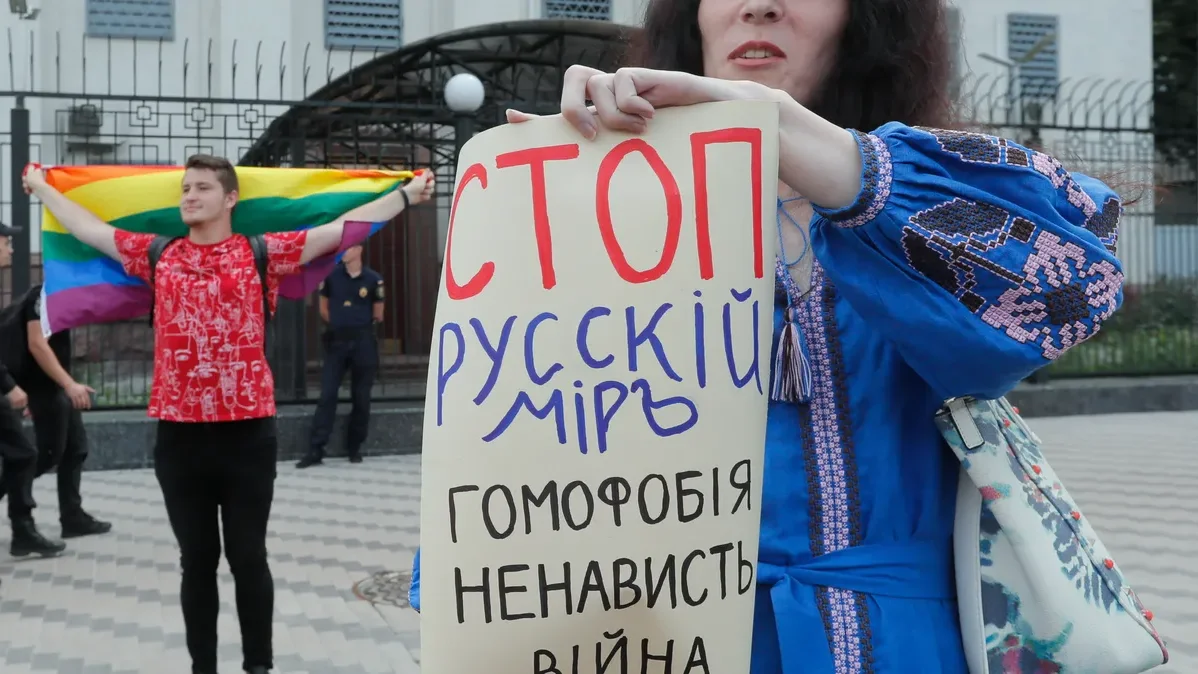
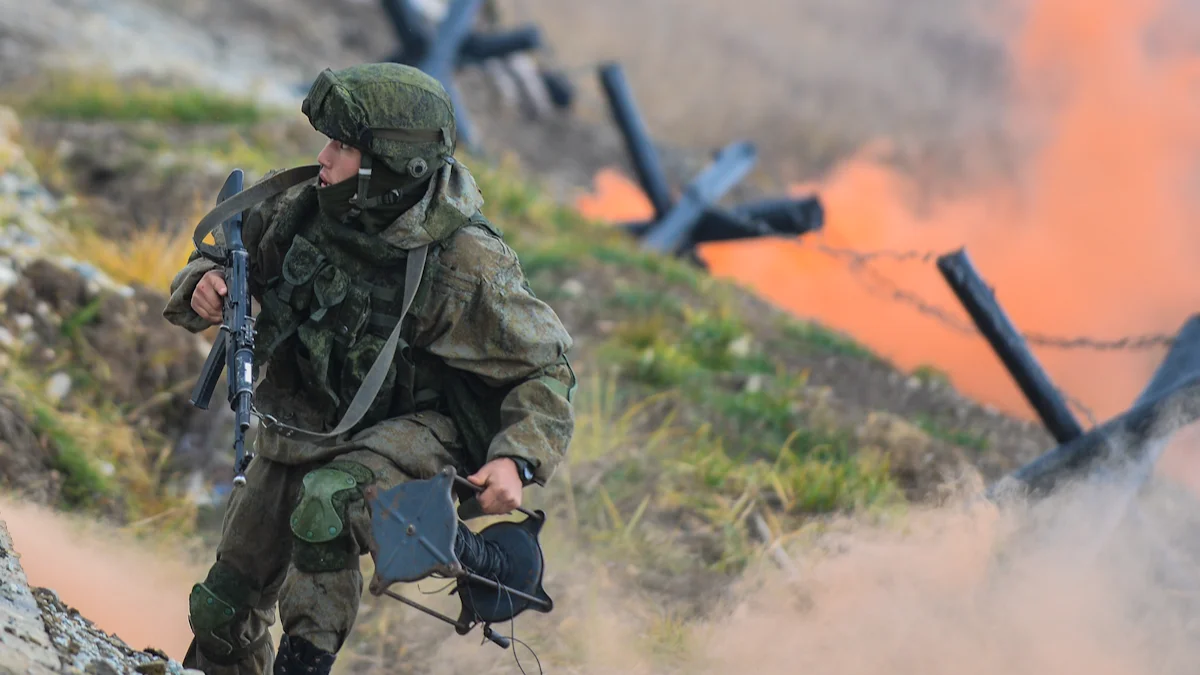
Putin has ascended the throne so long ago that it seems he was always there and everything else is just legend. In the first period of his reign he clearly sought to integrate Russia into the Western world. This is evident not only from his public speeches, but also from the fact that he was the first world leader to call President Bush after 9/11. He did not simply express his condolences, but also helped with intelligence on Afghanistan and agreed to a US base in Kyrgyzstan.

He told Kim Jong-il — the second dictator of the North Korean Kim dynasty — that he remembered the smoke of burnt documents billowing from the windows of the Stasi as he stood on the square among onlookers — and that if the Great Leader did not want this to happen in Pyongyang, he should make concessions (I cannot cite the source of this information, but it is more than reliable — take my word for it).

But integration did not work out. Putin did not just want to enter the club on equal footing — he wanted to join its privileged, senior members. Moreover, he did not understand the rules of this club, thinking that everything remained as it was at the end of WWII, when the leading countries divided the world among themselves — and he wanted to be among those leaders and partake of the division. But while Churchill and Roosevelt, given Stalin’s capabilities and ambitions at the time, might have had no choice but to agree with him, the world had changed since then. And it is not just that ever since the beginning of Putin’s rule Russia has been militarily weaker than the post-war USSR.

Of greater importance is the fact that a modern-day Yalta Conference is impossible in the same way that the Holy Alliance or the Ottoman Empire are impossible. It is not exactly that the days of hegemony are over — there are still attempts at it — but the days of consenting to hegemony are over.

It is truly lamentable that Russia missed its opportunity for integration. Some mistakes were made by the West, of course, but the main responsibility for the closing of this unique window of opportunity — there had been discussions of joining the EU and even NATO — lies with Russia and, above all, with Vladimir Putin personally. He did not want to obey the common rules — and this would continue happening time and time again.

Apparently, he reacted emotionally to his failure to become the new post-war Stalin for the world — he is a very emotional man. He became increasingly irritated and offended in his speeches, accusing the West of pushing away his outstretched hand. And he thus formed a new worldview wherein the whole planet is ruled by a spiteful force that hates Russia and all its good people, a planet in thrall to the US, which some of Putin’s future allies had long since called the Big Devil.

The road to this belief system was paved by his childhood in those St. Petersburg streets (that I firmly believe to be an invented concept) — that was where he supposedly learned to hit first, and then by his training and service in the KGB. This worldview was natural to him, whereas the ideas of Westernisation were something extraneous, incidental, which is why he gave them up so easily. He returned to his true self.

Accordingly, a new, even more ambitious goal emerged — to become the leader of the anti-American world.

Once again, as in Soviet times, any scoundrel became a friend as long as they were against America and the West.

But that did not work either — no one took Russia or him personally as a leader. The planet neither respected Russia nor envied it. There wasn’t even any serious fear before it. It turned out that a huge nuclear arsenal is not enough — you need something else. One does not get world leadership or even a place among other leaders when their country is mired in corruption, hypocrisy and lies — nobody will want to follow such a country. Two or three petty dictators can be bribed, of course, but even strong dictatorships will look at you with contempt, to say nothing of democracies.

So Putin decided to gain respect and recognition by force — through the invasion of Ukraine. He counted on the weakness and compliance of Western democracies, whom he had always treated with the same contempt as Stalin or Hitler did. He believed his own propagandists’ racist claims that the Ukrainians would not fight, that they would surrender, and that if anyone foolishly gave them arms they would just sell them to Russia anyway. Such thinking resulted in utter disaster.

Nobody knows how long the war will last and how it will end, but never before in its history has Russia demonstrated such a degree of powerlessness and inadequacy. There is no army — they are still unable to take the small town of Bakhmut, even with the huge losses. But there is raping and pillaging, perpetrated by common criminals who are recruited for the war as about a million potential soldiers have already fled from the draft. There is no state monopoly on force — some chef [PMC Wagner’s head Yevgeny Prigozhin, also known as “Putin’s chef” — translator’s note] is waging his own war. He may answer to the president, but he certainly does not answer to the minister of defence. There is no vaunted military-industrial complex — arms are in short supply, and Russia even has to resort to North Korea’s help. And there is no national leader either — note the lack of nationwide outrage over the ICC warrant — some rejoice but most do not care. By the way, here’s a piece of information for those rejoicing — the warrant is lifelong.

In this situation, the goal has changed yet again.

Putin’s Russia has switched from claiming leadership over the planet to Prince Alexander Nevsky’s dilemma — whose vassal to be, that of the West or the East?

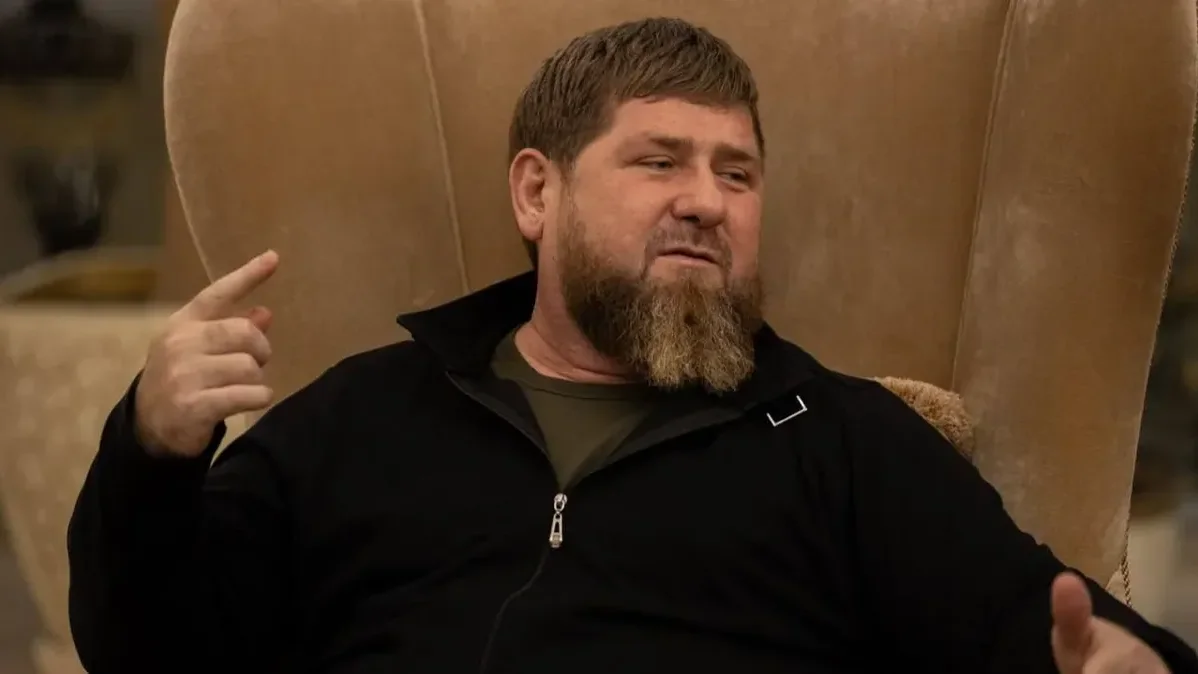
TV propagandists are already using the example of Nevsky to prove how right Putin is to lie down under China.

Personality psychology uses the concept of “aspiration level”. It is the level of achievement a person strives for, without which he feels like a failure. For some people it is a Nobel Prize, for others it is being promoted to head of their department. Naturally, if you fail all the time, your aspiration level gradually decreases, and eventually you will consider yourself quite successful for getting a small pay raise — no Nobel Prize needed.

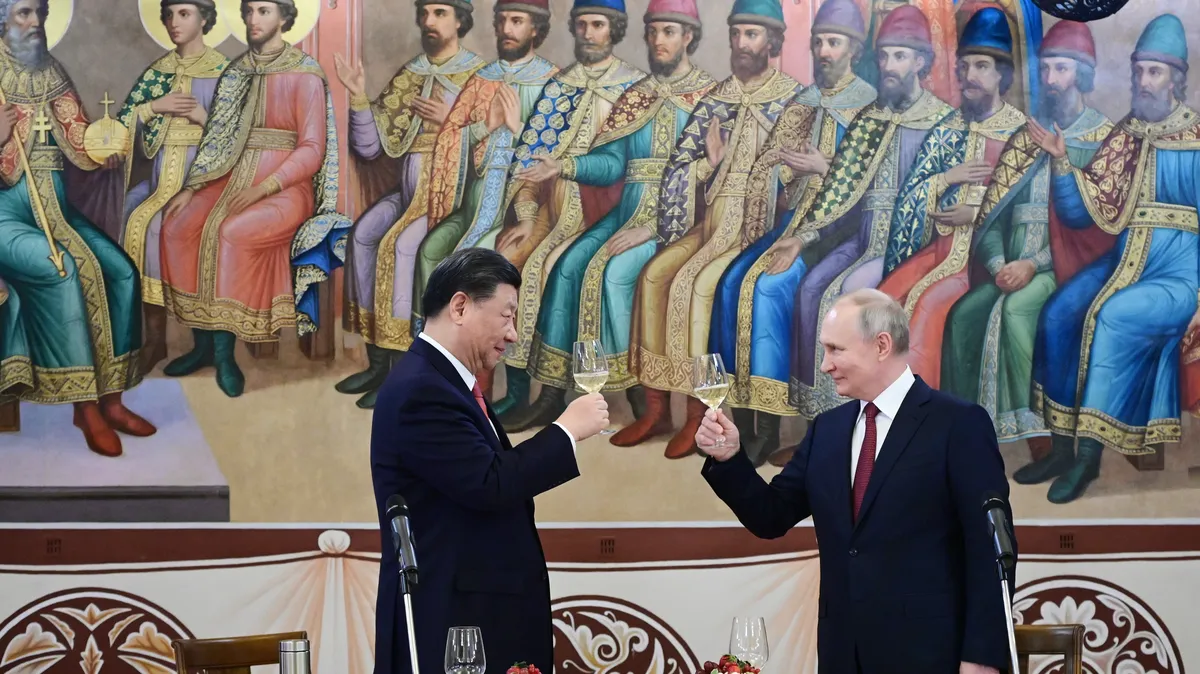
There is a very telling photograph from the recent talks between Xi and Putin — they are sitting exactly like Putin and Lukashenko had sat earlier, the latter looking suppliantly at a contemptuous Putin. Only now it is Putin looking that way at his new lord.

Russia’s moral decay
читайте также

Russia’s moral decay

Why people who are ready and willing to pull any nasty trick in the book at the regime’s behest are actually victims here, and who’s the worst among them

I do not know why Xi came to Moscow — it was a very strange visit. Both in the way it was conducted and in the utterly empty and meaningless declarations it produced. It was a visit that was humiliating for Putin — I am not sure he understands this yet. One glimpse of the humiliation — he supported Xi on Taiwan while Xi did not support him on the territories invaded by Russia. My hypothesis is that Putin is just a handy argument for Xi in his communication with Biden: if you do not give up Taiwan, I will be friends with Putin, I will give him weapons, so you, Mr Biden, will achieve nothing by 2024 and therefore lose the election. But all this will not affect Russia’s future — we are already vassals. This is the logical outcome of years of trying to dominate the world and play a zero-sum game.

The alliances Putin is trying to build are short-lived and unreliable. Trusty alliances, like the EU or NATO, are based not only on pragmatism but also on a sense of civilisational commonality. We could have been there too — it was Catherine the Great who said: “Russia is a European power”. We could have been part of them — after all, we feel European. Even if we are some kind of special Europeans, we are certainly not the Chinese.

They all look the same to us, and we all look the same to them. We can have good relations with individual Chinese people, but as a country, as a civilisation, they are strangers to us. And we are strangers to them.

So there is no way Russia’s vassal dependence on dictator-ruled China will be benign. It will probably be livable — just like it was during the Golden Horde. But there will be no national self-respect. And sooner or later, a national liberation movement will arise, and its activists will seek an alliance with the West. Maybe then Russia will start its return to Europe. But how can anyone know when it will happen? And whether it will happen?

Поделиться