Russia’s schoolchildren are being spoon-fed with “patriotism”: they march around wearing military uniform, hate Ukraine and NATO, and are literally taken on school trips to prisons. A research by Novaya Gazeta. Europe
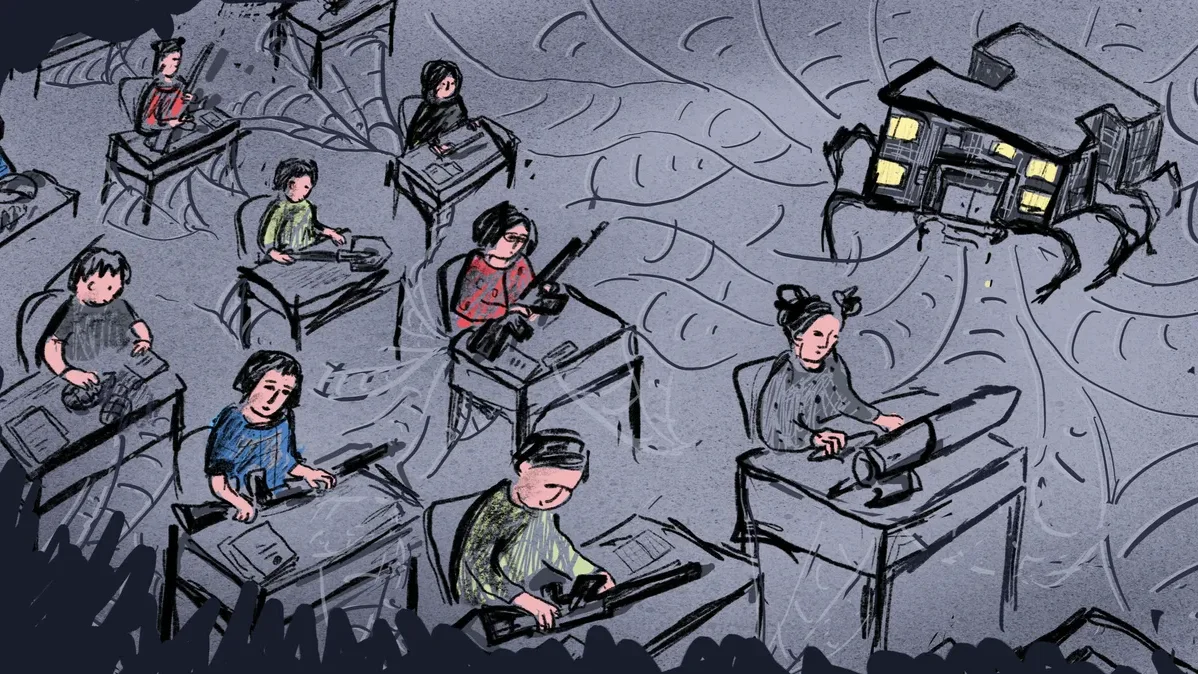
Children in Russia are being told about their “duty” to their homeland twice as often as about leading a healthy lifestyle. Today’s schoolkids are obliged to write letters to the soldiers in the battle zone, collect humanitarian supplies for the Russia-occupied regions of Ukraine, and celebrate the so-called Russian Spring. The teachers, in their turn, are forced to start each week by raising the national flag in front of the students and giving a lecture on the “special military operation”. We have analysed the events almost 9 thousand Russian schools have arranged since 2012. Here is our insight into how “ideological education” has become the key component of Russia’s school curriculum.
Sergey Kravtsov, Russia’s Education Minister, suggested that a formal procedure of raising the country’s flag to the sounds of the national anthem be held every Monday in all schools nationwide as he spoke at a forum in April. This, he said, will “help form the sense of patriotism and civic consciousness among the rising generation.” This will cost Russia’s state budget almost 1 billion rubles (€16.37m), as per the country’s government.
“The local prosecutor will supervise the whole thing; we’ll be obliged to raise the national flag each Monday morning and lower it Friday evening,” says Alexandra Korotayeva, a school teacher. “They forced us to purchase a flagpole worth over 20 thousand (€330) alone. Meanwhile, there is a shortage of textbooks in my school, so children have no choice but to share them with each other.”
“Lectures” on the “special military operation” (i.e., as the entire world puts it, the Ukraine War) will be obligatory for all school students starting 1 September 2022. Each Monday morning will begin with a homeroom session called “Important Talks”; the syllabus has been designed by the Education Ministry. Starting from grade 5, the kids will learn that Russia’s soldiers are “heroes” and “LPR and DPR citizens are ethnic Russians”, so their “comeback” into Russia’s territory is the country’s priority. From grade 3, they will be taught slogans such as “the homeland’s fortune means more than one’s life” or “the Motherland is worth dying for”. Finally, grade 1 kids (the first year of school, straight out of the kindergarten) will listen to songs like S chego nachinaetsja Rodina (What Does One’s Motherland Start From?) or Gljazhu v ozjora sinie (I Look into the Deep Blue Lakes). A total amount of classroom hours dedicated to “patriotic education” might go up to 1320.
Russia’s schools received guidelines on how to explain the country’s “peace-making operation” in Ukraine to children as early as March: the teachers were instructed to elaborate what the reason behind the “special operation” was, the meaning of the words “denazification” and “demilitarisation”, as well as the “markers of fake information”.
The session, as some high schoolers told us, included speaking of Ukraine as a “state with a fascist government” which “took power by illegal means and initiated a genocide against Russians” and listing reasons behind the invasion, such as: potential NATO expansion and Ukraine’s failure to abide by the Minsk agreements.
According to what some teachers told us, the PowerPoints were sent by the local authorities. Their goal was to explain how the events of 2014 and 2022 are connected and convince children that “helping and supporting Ukrainians” is the main objective of both the occupation of Crimea and the ongoing invasion.
Over 50 schools reported holding such meetings, another 450 schools took part in the “Letter to a Soldier” movement. The latter was designed by the Defence Ministry and Education Ministry in March. Zvezda, a nationwide TV channel, aired a story showing numerous primary schoolers in Belgorod sending triangle-shaped letters with Z and V symbols to the front line.
Source: Veterans of Russia
More than 50 thousand “patriotic events” have been held since 24 February in at least 400 schools nationwide, with titles such as “The Values and Heroism”, “The Heroes of Our Time”, “The Lessons of Courage”, “Russia’s Heroes”, and so on.
Apart from “talks” on Russo-Ukrainian relations, the schoolers are taught about “hybrid warfare” and how the Western countries “attack Russia using political propaganda, terror, disinformation and economic pressure.”
How the war came into schools
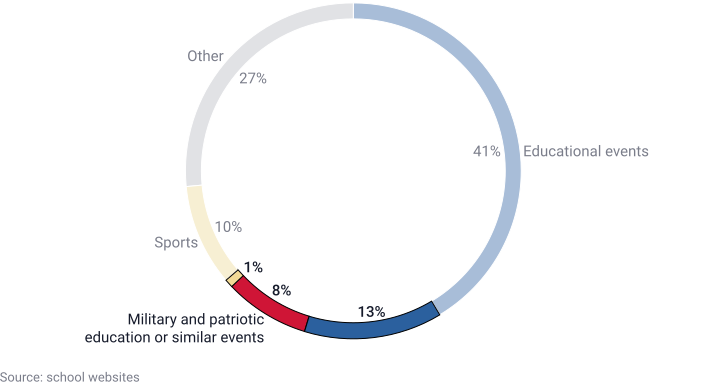
The implementation of the so-called “military and patriotic education” in Russia’s school policy has become a priority in the last 10 years. Over 20% of events organised by schools were of militaristic nature by 2021. For instance, Russia’s schoolchildren have annual events dedicated to the Crimea annexation, the Break of Siege at Leningrad, the Nazi Genocide of the Soviet People Remembrance Day, and the anniversary of USSR’s military withdrawal from Afghanistan.
Sports competitions, lectures on healthy eating or chess tournaments are held twice as seldom, i.e., less than 10% of the entire curriculum. 40% is dedicated to preparation for state exams (the equivalent of UK’s A-Levels — translator’s note), school Olympiads or other educational activities.
The percentage of school-organised events nationwide, 2021
Our methodology
We used the official websites for each school, found at uchi.ru and readik.ru. If a school website could not be found using the two databases, we used Google.
After reaching a school website, we searched for sections called “News”, “School Life,” “Events” and so on, and we also searched through URLs containing the same words. Then we downloaded those pages in html. As a result, we have collected information on 2.6 million events organised in 8803 schools nationwide.
In order to analyse an event’s topic, we used regular expressions to extract dates from html pages. We also set a 30 minute timer for our parser to download each given website. Obviously, not all of those schools had websites back in 2012, so we had to deal with unequal distribution. Therefore we had to set a limit at no more than 20% of new schools adding for each year. So, there are 2520 schools for 2022, 2620 for 2021, 2560 for 2020, 2080 for 2019, 1700 for 2018, and so on.
We used keywords to determine which class each event should be assigned to. For example, if an event report on a school’s website contains over 3 words of a given topic, the event is assigned to either “military and patriotic”, “sports” or “educational” category. Each event may be assigned to two classes: for instance, if a report contains words like “defender”, “homeland”, “Zarnitsa” [a Soviet-time children’s war game imitating military actions like reconnaissance or battles], “relay race”, “competition”, then it can be labelled as both “military / patriotic” and “sports” one.
We also used the titles of such events to analyse the popularity of certain activities. For instance, we used the words in quotes neighbouring words like “event”, “fest”, “relay race” or similar. Obviously, schools do not report all their events on their websites, so our stats are not 100% accurate.
Alexandra Korotayeva has been teaching Russian in a school located in a small village in the Smolensk region, Western Russia. The school’s spiritual and moral guidance has totally switched to the military topic, she says. “We used to speak of the war only on Victory Day when I went to school in the 1980s,” Alexandra says. “Today, I receive so many e-mails about military and patriotic events from the local administration that it is literally impossible to organise them all. If there is an essay competition, the topic is always something about the war. They demand so many events like it’s going out of fashion really, all my colleagues feel disgust and protest.”
All morale-building activities nowadays are run upon the military topics, as our sources say; each school’s calendar is filled with mandatory patriotic events.
The intensity of morale-building activities has grown by 200% in the last 11 years: apart from the Victory Day, Russian schoolchildren have the Leningrad Siege Remembrance Day in September, the Day of military Honour in November, the Defender of the Fatherland Day on 23 February, and the Day of Military Withdrawal from Afghanistan.
Patriotic education became a separate guideline within Russia’s educational standard in 2021. It is now used to design the curriculum and write officially authorised textbooks. A decree by the country’s Education Ministry says that a person who graduates school must not only be proficient in basic subjects, but also aware of their ethnic identity, interested in learning more about Russia’s history and culture and respectful to its achievements, national holidays, and historic legacy.
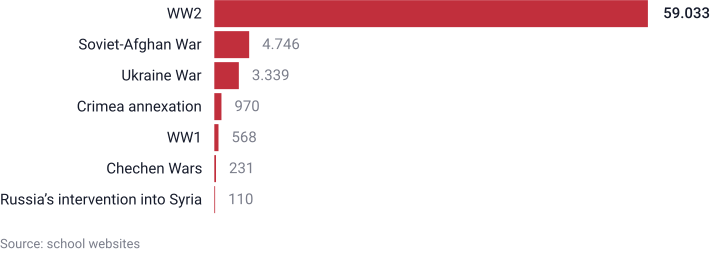
The entire patriotic education is mainly focused on one single date: 9 May 1945, the Soviet victory against Nazi Germany. Russia’s participation in WW1 or the Chechen Wars gets several hundred-fold less attention in schools.
The amount of school-organised events dedicated to wars Russia participated in
‘We visit the prison every week’
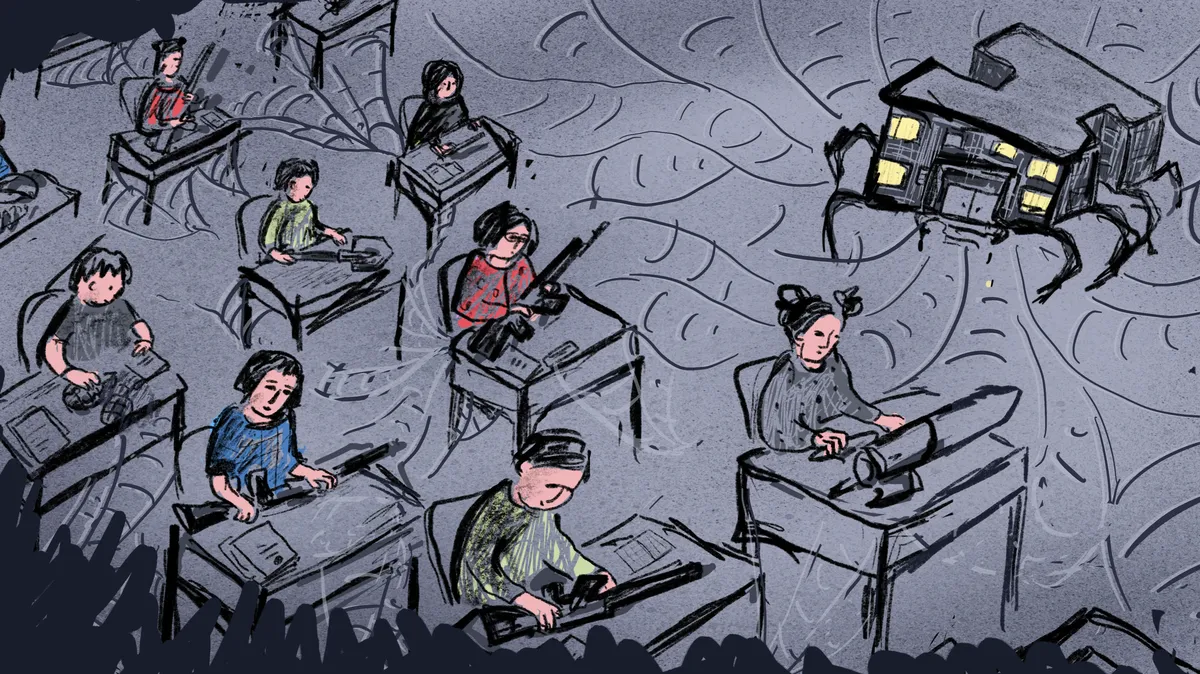
Grade 8 students from Moscow’s School #1571 have marching drills, assemble and disassemble AKs, and practice at using laser-beam rifles every week. They are members of the so-called “cadet class” and are different from other schoolchildren: they always wear military uniform, stand watch, partake in an Olympiad called “The Bridge Between the Generations” and in an annual parade at Moscow’s Poklonnaya Hill where the Victory Park, a huge outdoor WW2 memorial, is located.
A project which set up “cadet classes” in Moscow’s schools was introduced in 2014 when a total of 72 such classes were opened. By the end of their education, the cadets are expected to have perfect knowledge of all Russia-manufactured weapons, be able to use an assault rifle and dig trenches. A total of 260 schools in Moscow have cadet classes in 2022, and there are at least 730 schools nationwide which joined the project.
Source: No. 2038 school website
Members of the cadet class at a school in Murmansk, Northern Russia, visit the local maximum-security prison once a week. The prison guards show them cells, teach them combat moves and give them lectures on the history of firearms.
“They showed us how spetsnaz and K9 units work when we first visited the place,” says Nastya, the class monitor. “Next time we arrived they had a firearms exhibition for us. So, now we visit the prison once a week for drills. They teach us combat moves and how to (dis)assemble firearms.”
The students are required to wear black uniform, take part in a law competition, and listen to lectures. “The prison guards also involve us into certain activities like the Victory Day parade because we have this uniform,” Nastya says. “They often visit us at school, tell us of their work and provide advice to those who might want to join them after finishing school.”
Source: photo provided by students
Apart from the Federal Penal Correction Service, Russia’s Investigative Committee, National Guard, police, Federal Rescue Service and FSB also have their own “cadet classes”. Each agency provides extracurricular military training; some children get involved as early as the first year of school.
Do the math and fear not death
In 2020, Vladimir Putin suggested that the notion of morale education be expanded. It, as Russia’s leader put it, should be aimed at fostering the “sense of patriotism, civic consciousness, and respect towards the nation’s defenders.”
The State Duma, Russia’s parliament, immediately adopted amendments to the federal law on education. This is when the schools turned really militaristic: discussions about the Leningrad Siege, USSR’s withdrawal from Afghanistan and Hitler’s genocide against the Soviet people were declared mandatory at the dedicated homeroom sessions.
‘We are destined to serve Russia, you and I’
Irina (not her real name), a kindergarten teacher in Sochi, is responsible for making military clothing for six-year-old kids. The local administration has been organising a marching and singing competition for the past 10 years. The pre-schoolers sing the national anthem, march along, and train formation.
Each group of kids pretends to be a real military branch: rescue service, the Preobrazhensky regiment, cadets, nurses, cooks, etc. Irina’s group was representing Yunarmiya, a youth organization supported and funded by the Defence Ministry, this year. “They said we should dress the kids in military uniform: sand-coloured trousers and red polo shirts. We had to teach them the national anthem, Yunarmiya’s motto and a song called We are destined to serve Russia, you and I,” Irina says.
Her first experience with Yunarmiya dates back to 2019: “Their representatives would organise patriotic competitions for us every couple of months, and our kindergarten gave them a special room where they would store their uniform and hang their motto and the lyrics of the national anthem on the wall.”
It seems to Irina that the children do not quite realise what is going on. Their parents are generally content with the situation. “There has only been one person in these 10 years who got angry when he found out his child would be wearing military uniform,” Irina recalls. “Our headmaster requested his phone number to talk it over.”
Russia’s government aims at involving 24% of the citizens into the patriotic education system by 2024. Yunarmiya, the country’s main youth organisation, should have 1.7 million members by then, as the Education Ministry sees it.
Indeed, there are over a million kids within Yunarmiya now, and there are offices all across the country. It was created in 2016 on the initiative of Sergey Shoigu, Russia’s Defence Minister. Yunarmiya was aimed at “motivating the younger generation to abiding by the constitutional duty” and to “prepare young boys to serving for Russia’s army.”
Source: Yunarmiya
Although the UN Convention on the Rights of the Child, Russia’s Constitution and the Family Code prohibit military activities within educational institutions, at least 2,000 schools across the country organise Yunarmiya’s events every now and then. In the regions of Penza, Ryazan, and Lipetsk, approximately 25% of all schools have Yunarmiya units.
Source: Yunarmiya
“Today’s unemployment rates make military service one of the few means of social mobility for young men in poor regions of Russia,” says Yelena Omelchenko, head of the Centre for Youth Studies at the Higher School of Economics. “This, however, gives additional motivation to middle-class families to force their kids into higher education to avoid military service. The government, obviously, does not make it clear why military service is a duty for all young men. It was different back in the days of the Soviet Union when the government provided all its citizens with education and recreation free of charge. That is, the government had some sort of a contract with all young men in the country. It is definitely more challenging to motivate the teenagers to complete compulsory service these days.”