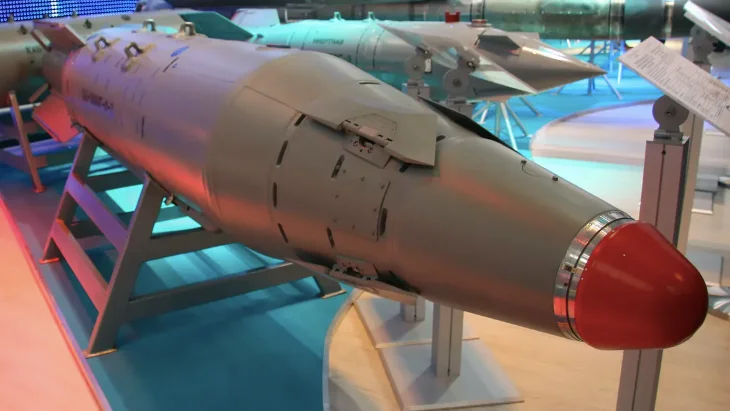
Several days ago, four Russian Su-35 fighters dropped five guided aerial bombs on the Kherson area in one day. Operational Command South of the Armed Forces of Ukraine (AFU) reports that those were KAB-500 munitions weighing 500 kg each.
American technology

“Russia has KAB-1500 guided aerial bombs, but to drop them, planes have to fly close to the front line, which means they have to enter the range of Ukrainian air defence,” Roman Svitan, a flight instructor and colonel in the AFU reserve, told Novaya-Europe. “The number of anti-aircraft missile systems of the AFU is constantly increasing, and soon the sky above the line of contact will be completely closed for flights of the Russian aviation.”

According to experts, in recent months, Russia has been able to set up production of “universal planning and correction modules”, called UMPKs, which can turn conventional bombs, such as FAB-500, into guided munitions that can hit targets dozens of kilometers away from the point of dropping.

“This new module with wings allows launching a gliding bomb from a distance of four dozen kilometers, where Ukraine still cannot reach the Russian planes,” continues Roman Svitan. “For this purpose, the aircraft must rise to an altitude of over ten kilometers and reach the speed of sound. And even in this situation, the AFU succeeds in attacking the Russians. The Ukrainian S-300 system managed to shoot down a SU-34 near Yenakiieve, after all.”

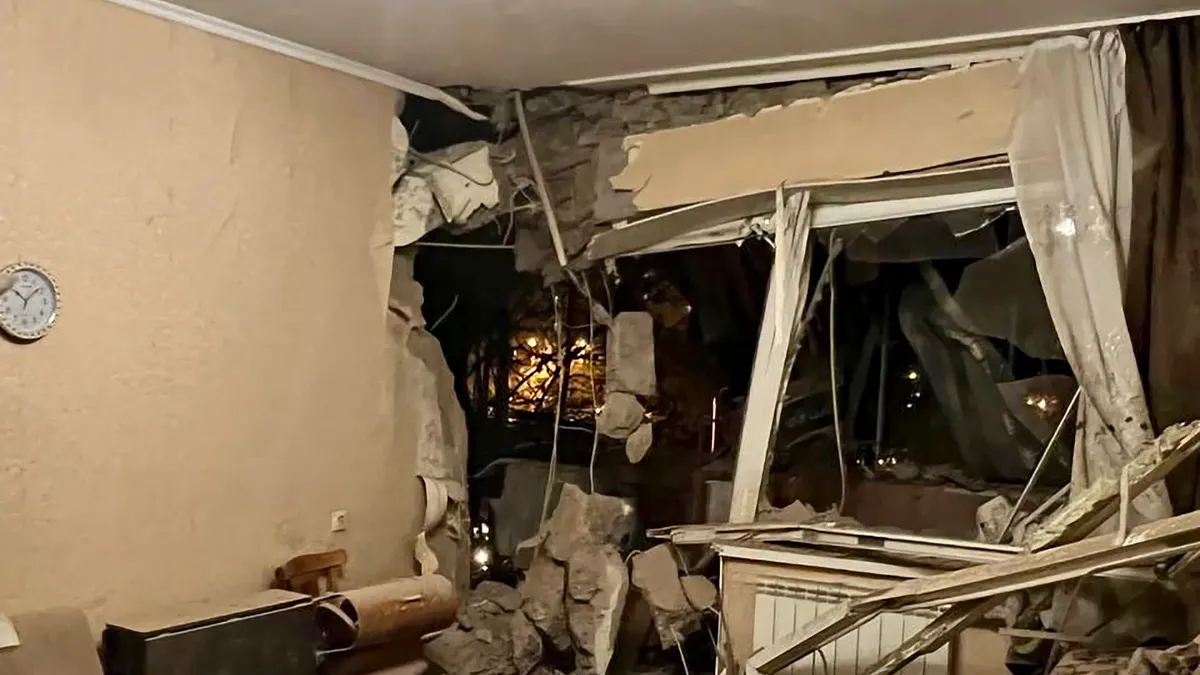
Russian media claimed that UMPK-equipped bombs destroyed a bridge in the Chernihiv region (Ukraine) used by Ukrainian saboteurs to penetrate into Russia’s Bryansk region. It was also reported that about ten half-ton FAB-500 equipped with UMPKs were dropped on the location of the 113th Brigade of Territorial Defence of the AFU in the Sumy region. On the other hand, it appears that ordinary FAB-500s, not equipped with a guidance and course correction system, were the ones that fell on Belgorod last week.

Russia bombing its own cities
читайте также

Russia bombing its own cities

A high-tech Russian bomb may have caused the explosion in Belgorod, a city near the border with Ukraine

Roman Svitan suggests that the Russian side used the American JDAM technology, which transforms conventional free-fall bombs into “smart” guided munitions, as a basis for the development of its UMPK. However, according to Svitan, the new bombs will not give Moscow a serious advantage on the battlefield. And with the deployment of Patriot anti-aircraft systems with a range of 150 km, Ukraine will completely suppress the use of aviation near the front line.

Wings without control

“Russia has been using high-precision bombs more and more often lately,” Israeli military columnist David Sharp tells Novaya-Europe. “Munitions like the KAB-500 have been around for a long time, and their use cannot be called a novelty. For example, guided bombs were dropped during the conflict in Syria. For many years Russia has been trying to create its own analogue of the JDAM kits produced in the United States. Recently it has become increasingly common to hear about Russia’s use of technology to convert free-falling 500-kilogram bombs into guided bombs. Samples of such weapons have already been found in various places — for example, in Donetsk, very far from possible targets of Russian aviation.”

Judging by the photos of wings and tail feathers available on the Internet, the production of these kits today in Russia is at a rather primitive level.

There are indications that such weapons can be inaccurate in hitting targets and generally unreliable.

David Sharp, citing his own sources in the war zone, says that Russian aviation has not become more effective recently. And guided aerial bombs, despite their prominent name, often hit civilian objects.

The Israeli observer hypothesises that the Russian glide bombs are equipped with wings that make it possible to drop them at long distances from the target, but not with a control unit. This means that such weapons cannot be called high-precision or even guided. Their whole point is the possibility of dropping bombs tens of kilometres away from enemy positions. This makes it possible to demolish cities, which is what is happening today in Avdiivka, and to have a psychological effect on the enemy.

The expert recalls that about ten years ago, guided bombs were not adopted by the Russian army due to high cost and lack of necessity. At that time, the price of one bomb reached 3 million rubles, which was more than $100,000. However, the Russian military asserted that installing the SVP-24 Gefest sighting and navigation system on the planes would make conventional bombing a high-precision attack, which does not correspond in any way to the real state of affairs.

It was only in March of this year that the information appeared in the press about the Russian army’s adoption of a new line of ultra-precise long-range bombs. The munitions included in it differ in caliber, range, and guidance systems.

According to the Russian mass media, the new items are able to fly tens of kilometers and hit not only stationary objects, but also moving vehicles and even tanks. The development of the new line of high-precision aviation bombs allegedly began last year. At the beginning of this year, they underwent military tests, where they generally performed well.

“Aviation is a strong bargaining chip for Russia today,” Sharp concludes. “If we assume that Russia will continue to actively increase the use of such munitions, it could have an impact on the situation in some parts of the front. But to do that, you really need to massively increase the use of such weapons. And to achieve an increase in their effectiveness.”

“In this situation, Ukraine can only hope for air defence and the possible supply of Western fighter jets that can shoot down Russian bombers at a considerable distance.”

These words are confirmed by Yuriy Ihnat, Ukrainian air force spokesman: “This is a new threat that appeared before us: without flying into the defeat zone of our air defence, they are dropping these bombs. 500-kg bombs fly dozens of kilometers, and this bomb has a warhead. Something should be done about it. Not only with air defence systems, which we are waiting for, but we also need to increase pressure and work with Western partners to create an aviation coalition and provide Ukraine with fighter jets.”

Поделиться
Темы
More stories
Как хотят наказывать за «отрицание геноцида советского народа»

Как хотят наказывать за «отрицание геноцида советского народа»

«Новая-Европа» разбирается в новом законопроекте, жертвами которого могут стать журналисты, историки и учителя

Джей Ди Вэнс едет на Южный Кавказ

Джей Ди Вэнс едет на Южный Кавказ

Каковы интересы Америки и какие новые геополитические смыслы обретает регион?

Маменькин сынок

Маменькин сынок

История «сибирского потрошителя» Александра Спесивцева

Разведка в Абу-Даби

Разведка в Абу-Даби

Кто такой Игорь Костюков — начальник ГРУ, возглавивший российскую делегацию на переговорах по Украине

Друзьям — деньги, остальным — закон

Друзьям — деньги, остальным — закон

Кто получает путинские гранты: от больницы РПЦ до антивоенных активистов

Три миллиона файлов по делу Эпштейна

Три миллиона файлов по делу Эпштейна

Трамп и другие контакты: что удалось обнаружить в новом и, возможно, последнем крупном массиве документов?

Поймай меня, если сможешь

Поймай меня, если сможешь

«Марти Великолепный» с Тимоти Шаламе — один из лучших фильмов сезона, рассказывающий историю об игроке в пинг-понг как криминально-авантюрную сагу

«Отношение к ним в Европе жестче, чем в первый год войны»

«Отношение к ним в Европе жестче, чем в первый год войны»

Что сейчас происходит с российскими дезертирами?

Что известно о ПНИ Прокопьевска, где из-за вспышки гриппа умерли девять человек

Что известно о ПНИ Прокопьевска, где из-за вспышки гриппа умерли девять человек

Сотрудники там жаловались на условия содержания пациентов: холод, испорченную еду и отсутствие лекарств