Kids with guns
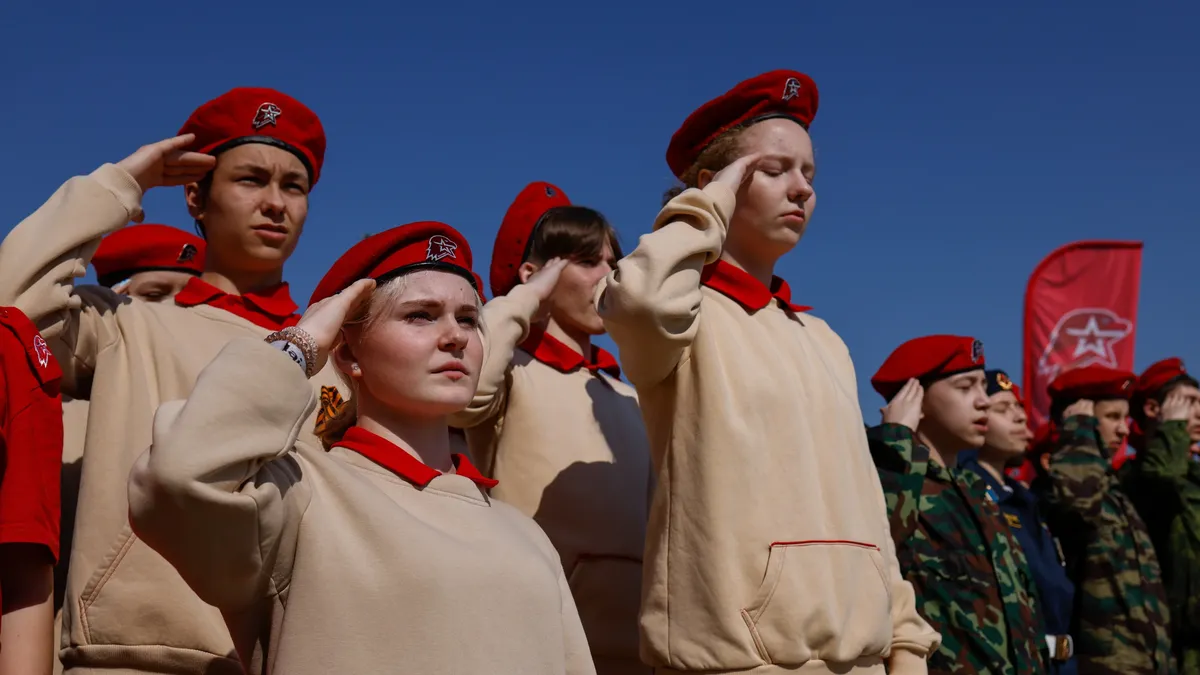
Russia’s schoolchildren are being spoon-fed with “patriotism”: they march around wearing military uniform, hate Ukraine and NATO, and are literally taken on school trips to prisons. A research by Novaya Gazeta. Europe
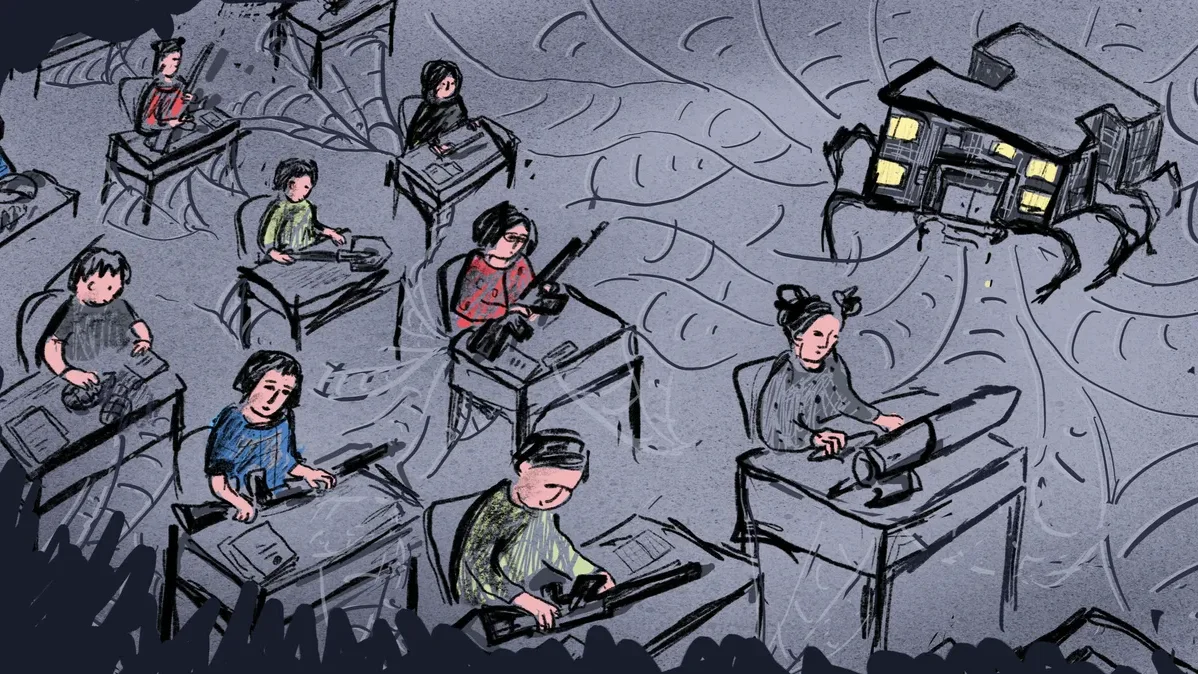
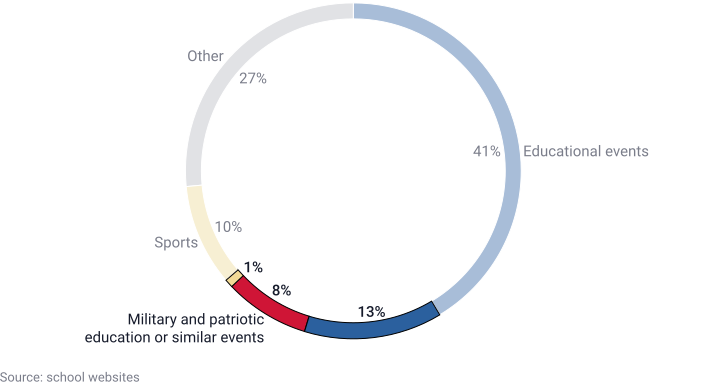
Children in Russia are being told about their “duty” to their homeland twice as often as about leading a healthy lifestyle. Today’s schoolkids are obliged to write letters to the soldiers in the battle zone, collect humanitarian supplies for the Russia-occupied regions of Ukraine, and celebrate the so-called Russian Spring. The teachers, in their turn, are forced to start each week by raising the national flag in front of the students and giving a lecture on the “special military operation”. We have analysed the events almost 9 thousand Russian schools have arranged since 2012. Here is our insight into how “ideological education” has become the key component of Russia’s school curriculum.
More than 50 thousand “patriotic events” have been held since 24 February in at least 400 schools nationwide, with titles such as “The Values and Heroism”, “The Heroes of Our Time”, “The Lessons of Courage”, “Russia’s Heroes”, and so on.
Our methodology
After reaching a school website, we searched for sections called “News”, “School Life,” “Events” and so on, and we also searched through URLs containing the same words. Then we downloaded those pages in html. As a result, we have collected information on 2.6 million events organised in 8803 schools nationwide.
In order to analyse an event’s topic, we used regular expressions to extract dates from html pages. We also set a 30 minute timer for our parser to download each given website. Obviously, not all of those schools had websites back in 2012, so we had to deal with unequal distribution. Therefore we had to set a limit at no more than 20% of new schools adding for each year. So, there are 2520 schools for 2022, 2620 for 2021, 2560 for 2020, 2080 for 2019, 1700 for 2018, and so on.
We used keywords to determine which class each event should be assigned to. For example, if an event report on a school’s website contains over 3 words of a given topic, the event is assigned to either “military and patriotic”, “sports” or “educational” category. Each event may be assigned to two classes: for instance, if a report contains words like “defender”, “homeland”, “Zarnitsa” [a Soviet-time children’s war game imitating military actions like reconnaissance or battles], “relay race”, “competition”, then it can be labelled as both “military / patriotic” and “sports” one.
We also used the titles of such events to analyse the popularity of certain activities. For instance, we used the words in quotes neighbouring words like “event”, “fest”, “relay race” or similar. Obviously, schools do not report all their events on their websites, so our stats are not 100% accurate.
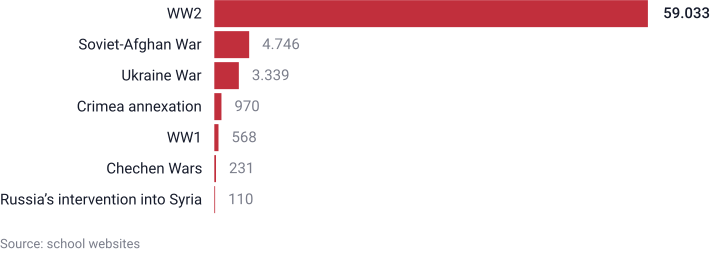
We have compiled a huge graph of events based on how many schools organised them. Sports and educational events make up ⅔ of the total amount, including humanitarian and charity activities. The remaining 33% are events dedicated to commemorative dates in Russia’s military history, marked in red here. That said, only 8 events aimed at fostering patriotism in children were not connected to military holidays. We marked those in blue.
Russia’s first “patriotism education” project was introduced in 2006 when schools received study guides titled “Let us raise Russia’s patriots”. In 2005, the Saint George’s Ribbon patriotic campaign was set up by RIA Novosti and Studencheskaya Obshchina. Over 800 educational institutions have joined the campaign nationwide as of 2022.
The Immortal Regiment campaign, a civic event set up by Tomsk activists which later fell under control of the state, came to Russia’s schools in the mid-2010s. It has become the most popular school event after seven years: over 1,500 schools took part in the campaign in May 2022.
“My neighbourhood in the time of war” is a huge patriotic project by Moscow’s authorities which later became a competition for schoolchildren. They would upload their works to the website which had an interactive map of Moscow where WW2- related locations were marked.
The project also involved children in laying flowers at those locations in their neighbourhood and singing military songs in a choir. These events are held three times each year: on Victory Day (9 May), Day of Remembrance and Sorrow (22 June) and the Day of the Moscow Counteroffensive (5 December).
Another patriotic event organised by Moscow’s authorities is the Fatherland’s Spiritual Bonds festival which has four parts each year.
In 2022, a campaign called The Siege of Leningrad Bread became second popular among Russia’s schools after the Immortal Regiment: 17 % of schools joined it. The campaign had a 125g piece of bread as its symbol.
At least 680 schools joined the Windows of Victory campaign in 2022. As part of the campaign, children decorate the windows of their classrooms with symbols of the Soviet WW2 victory made of paper: flowers, Saint George’s ribbons, and eternal flames.
“Our teachers have a very special goal on their hands, they need to teach our children how to identify the markers of genocide, no matter what slogans or noble causes it uses as disguise,” said Yelena Tsunaeva, the organiser of the No Limitation Period campaign. The campaign is aimed at lecturing children on the crimes by “Germany’s fascists, Ukraine’s Banderovites and Estonia’s chastisers” during WW2. After the lecture is over, the kids must post their opinion on those crimes on their social media.
The Garden of Memory, another campaign that was supported by over 500 schools. The children would plant over 27 million trees in the memory of the WW2 victims, as well as “ the deceased soldiers who protect the dignity and honour of their homeland” in Ukraine.
“Drawing the Victory”, a drawing competition, reported a record figure of 740 thousand participants in 2022 and invited children of 4 years and older. Here are the titles of the winning paintings: Back to the Front Line Straight from the Hospital, Mother’s Grief, Death Notice, and Saving a Wounded Combatant.
The Crimean Spring, a campaign commemorating the 2014 Crimea annexation, was supported by over 1500 schools in 2022. “We had no obligation to organise a lecture on Crimea annexation up until 2022; they allowed us to treat their requests very formally. But this year it was all different, and they made a special focus on the Crimean Spring,” says Daniil Ken who used to work as a school teacher between 2011 and 2020.
Endlessly offensive
Could recent military activity in Ukraine’s Zaporizhzhia region signal a fresh Russian advance?
A short history of hate
How Russia’s pro-government media learned to target ‘internal enemies’
Coming home to roost
How veterans of the war in Ukraine are reshaping Russia’s crime statistics
Road from Damascus
Why Moscow is scaling back its presence in Qamishli, a key military facility in northeastern Syria
Heir abhorrent
A multi-car pile up in Grozny has provided rare insight into Chechen warlord Ramzan Kadyrov’s succession plans
Flag fall
Ukraine is looking increasingly like the victor in the battle for Kupyansk
Fresh blood
What Zelensky’s appointment of Ukraine’s former military intelligence head as his chief of staff could signal for the country
Stolen youth
How Russia made young people’s lives worse in 2025
The war across Russia
Drone strikes on Russia’s regions reached record levels this year, with an average of 11 crashing or striking their targets daily