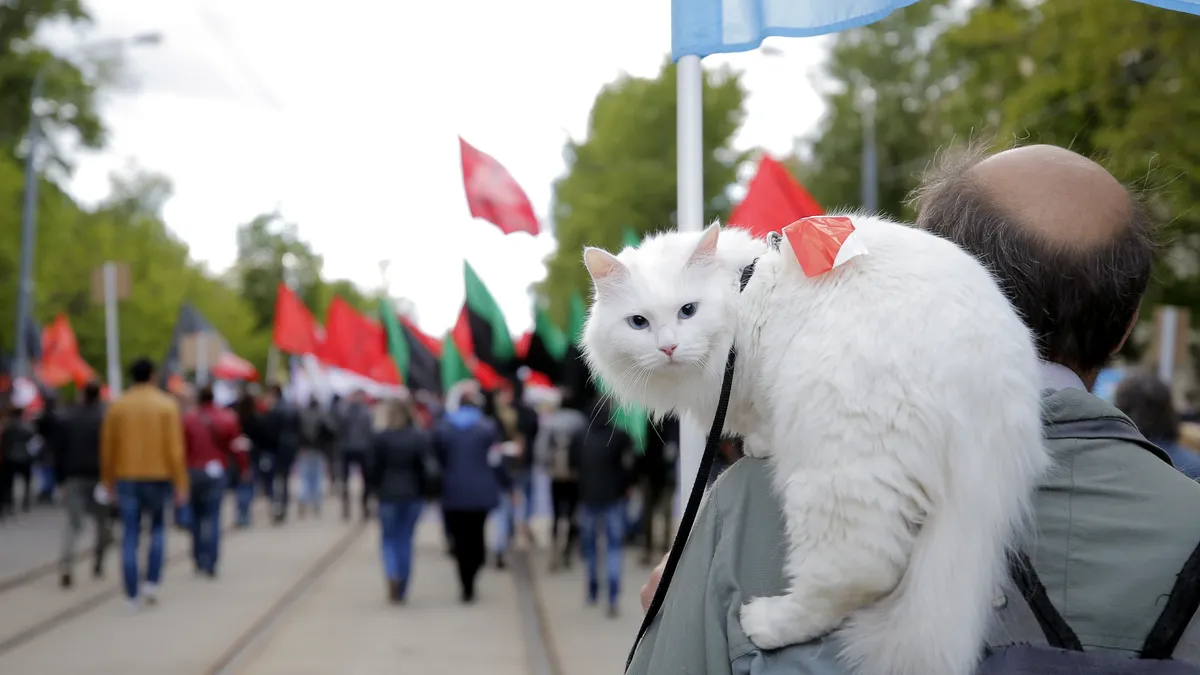
Last month Russia experienced a rare moment of unity over the death of a pet cat that was thrown off a train in freezing weather. Some 380,000 people signed a petition demanding that the employee responsible be dismissed, and another 180,000 demanded a criminal case to be launched against her.

By comparison, a petition demanding the release of jailed opposition politician Alexey Navalny’s started by Novaya Gazeta in 2021 gathered just over 220,000 signatures, while a similar call for the release of opposition politician Ilya Yashin gained only 70,000 supporters in 2022.

Twix the cat, who escaped his carrier while travelling from Yekaterinburg to St. Petersburg, was thrown into the snow during a stop in the city of Kirov on 11 January after the conductor found him in the train corridor and mistook him for a stray.

The moment was caught on CCTV footage and went viral on social media, leading to a massive search effort by volunteers across the region and prompting an official response from Russian Railways, who apologised to the cat’s owners and promised to review their animal handling protocol.

One of Russia’s biggest state news outlets, RIA, dedicated at least 10 articles to the cat, while another state-affiliated newspaper published a detailed timeline — a format usually reserved for major news events — on what happened to it.

Petitions on Russian social media quickly gained traction, with some demanding the dismissal of the conductor responsible and others demanding she face criminal charges. A few State Duma deputies spoke out on the issue, calling for more robust animal protection laws. One deputy, Vladimir Burmatov, announced that he had been appointed head of a committee dedicated to ensuring that another “tragedy” like the one with Twix would be “impossible”.

The public pressure led Russian Railways to temporarily dismiss the conductor while it completed an internal investigation.

Stories of cat-related injustice often make headlines in Russia’s state-funded and independent media alike: among the less tragic recent protagonists was Markiz the cat, who was kicked out of a public library in Moscow following a visitor complaint and who was subsequently adopted by the head librarian. Burmatov was quick to jump to the cat’s defence once again, noting that “there are no rules against keeping cats in libraries”.

Another cat, Spicy, who was heavily injured, was thrown out in the snow by a vet in Nizhny Novgorod in late January. A petition was launched online calling for the police to launch a criminal case against the vet for animal cruelty, with activists planning to bring the matter to the regional governor and the Ministry of Agriculture.

It’s perhaps unsurprising that cat-related injustice provokes such fury in Russia. Nearly half of the country’s households have pet cats, the highest rate in the world.

Psychologist Olga Kozlovskaya* also said that the suffering of animals and children, both of which are typically viewed as “defenceless”, tends to attract much more sympathy than the suffering of adults.

But the public response to Twix’s death went beyond sympathy and to true rage. Another female train conductor who was mistaken for the woman in the video received hate mail and death threats, her daughter reported.

Experts have suggested that for some Russians, Twix’s story may have become a way to vent emotions that have been suppressed by the increasing censorship seen since the full-scale invasion of Ukraine.


Kozlovskaya speculated that many Russians were living with feelings of “internal aggression” caused by the war in Ukraine. She suggested that they may have found it both easier and safer to lash out at an unknown train conductor than to blame politicians or take action against the war.

Political scientist Yekaterina Schulmann also said she viewed the public outcry as symptomatic of deeper trauma within society. In today’s Russia, she said on her weekly radio program, it is “forbidden to mourn the dead”, including dead friends and family members. “That’s why the whole country is crying over a cat — these are unshed tears over something else.”

*Not her real name

Поделиться
Темы
More stories
Как хотят наказывать за «отрицание геноцида советского народа»

Как хотят наказывать за «отрицание геноцида советского народа»

«Новая-Европа» разбирается в новом законопроекте, жертвами которого могут стать журналисты, историки и учителя

Джей Ди Вэнс едет на Южный Кавказ

Джей Ди Вэнс едет на Южный Кавказ

Каковы интересы Америки и какие новые геополитические смыслы обретает регион?

Маменькин сынок

Маменькин сынок

История «сибирского потрошителя» Александра Спесивцева

Разведка в Абу-Даби

Разведка в Абу-Даби

Кто такой Игорь Костюков — начальник ГРУ, возглавивший российскую делегацию на переговорах по Украине

Друзьям — деньги, остальным — закон

Друзьям — деньги, остальным — закон

Кто получает путинские гранты: от больницы РПЦ до антивоенных активистов

Три миллиона файлов по делу Эпштейна

Три миллиона файлов по делу Эпштейна

Трамп и другие контакты: что удалось обнаружить в новом и, возможно, последнем крупном массиве документов?

Поймай меня, если сможешь

Поймай меня, если сможешь

«Марти Великолепный» с Тимоти Шаламе — один из лучших фильмов сезона, рассказывающий историю об игроке в пинг-понг как криминально-авантюрную сагу

«Отношение к ним в Европе жестче, чем в первый год войны»

«Отношение к ним в Европе жестче, чем в первый год войны»

Что сейчас происходит с российскими дезертирами?

Что известно о ПНИ Прокопьевска, где из-за вспышки гриппа умерли девять человек

Что известно о ПНИ Прокопьевска, где из-за вспышки гриппа умерли девять человек

Сотрудники там жаловались на условия содержания пациентов: холод, испорченную еду и отсутствие лекарств