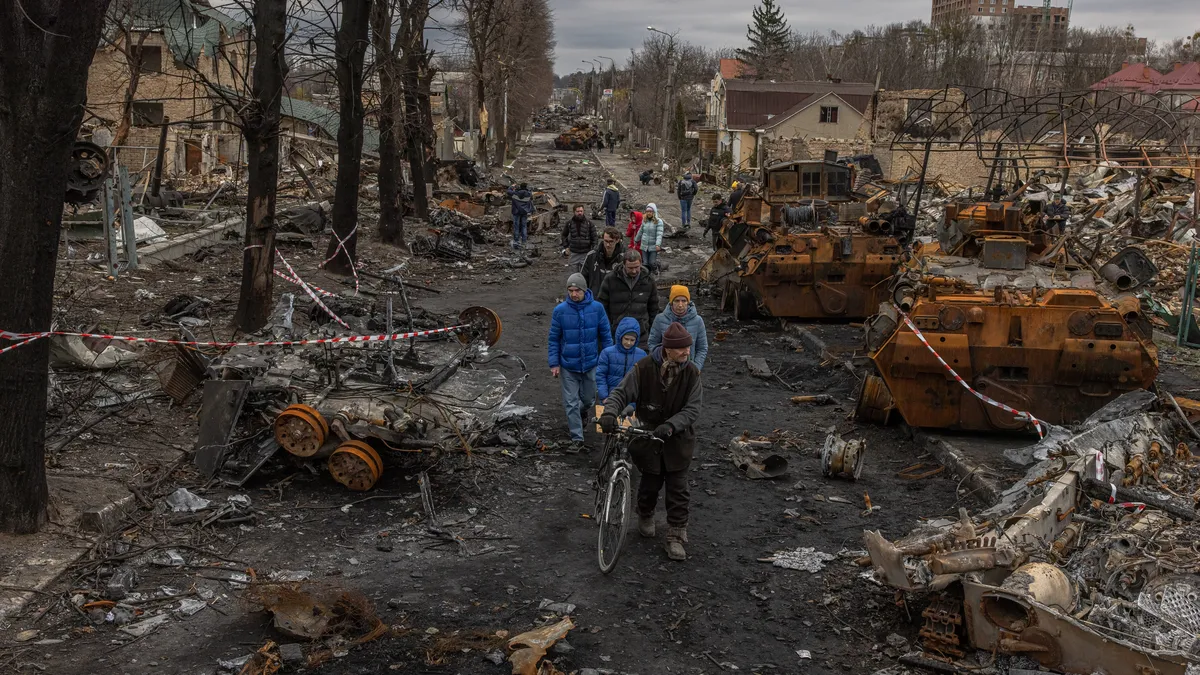
Residents walk past the wreckage of dozens of Russian military vehicles in the town of Bucha following a brutal month-long occupation in which hundreds of Ukrainian civilians were tortured and killed, 6 April 2022. Photo: EPA-EFE/ROMAN PILIPEY
As the full-scale Russian invasion of Ukraine enters its ghoulish 1,000th day on Tuesday, the odds of Kyiv ultimately prevailing in its extraordinary effort to defend its own territory from its overwhelmingly more powerful neighbour appear lower than at almost any point in the war before.
The American electorate’s decision to return Donald Trump to the White House in January has catalysed an already growing feeling of frustration in the US at Washington’s involvement in the war and the scale of its military and financial assistance to Kyiv, even though the cost of a full-scale NATO war with Russia would dwarf the West’s current expenditure.
Now a sword of Damocles hanging over the Ukrainian leadership, Trump’s return renders the most convincing argument for supporting Ukraine’s territorial sovereignty moot, given his belief that there is no inherent value to democratic states, much as dictatorships give no automatic rise to moral qualms.
Despite the next few months looking extremely bleak for Volodymyr Zelensky, the Ukrainian people have achieved something few would have thought possible just a few years ago. A war that was supposed to last just three days, according to Russian propagandists, has now lasted almost three years, and has become the most significant conflict in Europe since World War II. To mark the tragic milestone of 1,000 days since the Russian invasion, Novaya Gazeta Europe looks back at some of the key events in the war so far.
DAY 1: Russia invades Ukraine
In a nearly 30-minute video address broadcast at 6am on Thursday, 24 February 2022, Vladimir Putin announced the start of what he called a “special military operation” in Ukraine, after months of issuing warnings to the government in Kyiv over its ever-closer ties to the West. What the Kremlin boasted would be a quick blitzkrieg would turn out to become a protracted war that would claim hundreds of thousands of innocent lives, however. “Today’s events are not connected with a desire to infringe on the interests of Ukraine and the Ukrainian people,” Putin said as Russian forces shelled Ukrainian cities, leading to gridlocked roads as people fled for Ukraine’s western borders.
Smoke rises in the distance as Kyiv residents begin fleeing the Ukrainian capital on 24 February 2022. Photo: EPA-EFE/SERGEY DOLZHENKO
DAY 21: Mariupol Drama Theatre strike
The Ukrainian port city of Mariupol was besieged by Russian forces as well as pro-Russian militias on the first day of the war, and by mid-March the relentless shelling of the Ukrainian-held city saw over 80% of its buildings razed to the ground. On 16 March 2022, despite painting the word “children” on the ground outside to inform Russian troops that the building was being used as a bomb shelter, a devastating direct strike on the Mariupol Drama Theatre killed somewhere between 200 and 600 people, in an attack that shocked the world and that was internationally condemned as a war crime.
The word “children” is still clearly visible painted on the ground outside the ruins of the Mariupol Drama Theatre, 17 March 2022. Photo: Pavel Klimov / Reuters
DAY 37: Liberation of Bucha
Ukraine’s determination to resist the Russian invasion quickly undermined the Kremlin’s claims that a speedy victory was on the cards, however. One month into the war, Russian troops were forced to abandon their offensive on Kyiv, withdrawing from the region around the capital in what the Russian Defence Ministry laughably called “a gesture of good will”. However, what Ukrainian troops saw as they entered the small town of Bucha on 1 April 2022 horrified the world and has since become synonymous with Russian war crimes: the bodies of murdered civilians littered the streets, many of them still with their hands bound behind their backs, a telltale sign of summary execution.
Bodies of Ukrainian civilians killed during the Russian occupation lie on a street in Bucha, near Kyiv, 3 April 2022. Photo: EPA-EFE/MIKHAIL PALINCHAK
DAY 83: The fall of Mariupol
The Russian siege of Mariupol, one of the darkest chapters of the war, ended on 17 May 2022 as the last Ukrainian holdout at the Azovstal Steelworks was forced to surrender to the Russian military. The siege of Mariupol’s true death toll is still unknown, as the city remains under Russian occupation today. However, in just under three months, an entire city of over 400,000 people, was almost entirely reduced to rubble as Russia shelled residential areas mercilessly and indiscriminately, killing at least 8,000 civilians according to Human Rights Watch.
Numbers mark the graves of unidentified local civilians who were killed during the Battle of Mariupol. Photo: EPA-EFE/SERGEI ILNITSKY
DAY 124: Shopping mall strike in Kremenchuk
On 27 June 2022, a Russian cruise missile targeted a busy shopping centre in the central Ukrainian city of Kremenchuk, despite it being nowhere near the frontlines, killing at least 20 people. The Russian Defence Ministry claimed that the missile had targeted a weapons depot at a nearby factory, but that the “detonation of munitions” had spread to the “non-functioning” shopping mall, something Ukrainian officials denied.
Mourners attend the funeral ceremony of Andriy Krasyuk, one of those killed in the Russian missile strike on the Amstor shopping mall in Kremenchuk, Ukraine, 30 June 2022. EPA-EFE/PAVLO PAKHOMENKO
DAY 141: Missile strike on Vinnytsia
On the morning of 14 July 2022, Iryna Dmytrieva, the mother of four-year-old Liza, posted a short video with her daughter on their way back from the doctor’s office in Vinnytsia, a city in central Ukraine. Just a few hours later, Russian forces would launch a missle strike on Vinnytsia’s central square, killing 28 people. Iryna was severely injured but survived the attack. Liza did not make it. “I keep asking why I lived … I didn’t want to. Time goes by, but my pain remains,” Iryna, who is now recovering from her injuries in Austria, told Ukrainian broadcaster Suspilne in 2023.
First responders work at the site of a missile strike on the western Ukrainian city of Vinnytsia, 14 July 2022. Photo: EPA-EFE/ROMAN PILIPEY
DAY 199: Ukraine successfully counterattacks
The first major Ukrainian counteroffensive of the war began in early September 2022 and saw the Armed Forces of Ukraine liberate several key cities in the Kharkiv region, including Kupiansk on 10 September 2022. The surprise attack took advantage of the fact that Russia was sorely lacking in manpower and military equipment. The occupying Russian forces in Kharkiv region were forced to flee back over the Russian border in a humiliating retreat.
A boy waves a Ukrainian flag in the recently liberated city of Kupiansk in Ukraine’s eastern Kharkiv region, 11 October 2022. Photo: EPA-EFE/George Ivanchenko
DAY 210: Putin announces mobilisation
Despite repeated assurances to the Russian public made by both the Defence Ministry and multiple Kremlin officials that the “special military operation” in Ukraine would not require a military draft, in a televised address on 21 September 2022, Vladimir Putin announced the “partial mobilisation” of approximately 300,000 reservists, prompting thousands of draft-age men to flee the country before they could be tracked down by enlistment offices. Anti-mobilisation protests — some of the last large public protests to take place in Russia — happened across the country, but were swiftly and violently quashed by riot police units.
Russian police move in to detain people protesting against partial military mobilisation in St. Petersburg, Russia, 21 September 2022. Photo: EPA-EFE/ANATOLY MALTSEV
DAY 219: Russia absorbs four Ukrainian regions
As Ukraine continued its successful counteroffensive in the Kharkiv and Kherson regions, on 30 September 2022, Putin, flanked by the four Russia-appointed “heads” of the occupied Donestsk, Luhansk, Kherson and Zaporizhzhia regions, held a pompous ceremony in the Kremlin to announce their unilateral annexation after a series of sham referendums held under Russian rule. “Welcome home,” Putin proclaimed as he took the stage afterwards at a patriotic concert near the Kremlin, adding that only Russia had been able to give the people living in the occupied regions “the right to choose” to be with their “historic homeland”. To this day, Russia has yet to obtain full control over any of what it dubs its “new territories”.
Vladimir Putin addresses a crowd on Moscow’s Red Square celebrating the illegal, unilateral accession of four Ukrainian regions to the Russian Federation on 30 September 2022. Photo: EPA-EFE/MAKSIM BLINOV
DAY 261: Ukraine liberates Kherson
On 11 November 2022, the Armed Forces of Ukraine liberated the city of Kherson, giving Ukraine its first real hope for victory after the first horrific months of the war. Since then, the Kherson region has been divided, with the region’s right bank including its eponymous capital under Ukrainian control, while the left bank of the Dnipro River is controlled by the Russians.
Celebrations following Ukrainian President Volodymyr Zelensky’s visit to the newly liberated city of Kherson, 14 November 2022. Photo: EPA-EFE/OLEG PETRASYUK
DAY 312: Makiivka missile strike
As the rest of the world was celebrating the start of the new year, a Ukrainian missile strike on a makeshift barracks in the city of Makiivka in occupied eastern Ukraine killed at least 89 Russian troops, and possible several hundred, many of whom had been drafted into the army during the mobilisation drive just a few months beforehand. The Russian Defence Ministry’s death of 89 was the highest of its kind to have been confirmed by Russian military officials so far during the war.
Russian uniforms lie among the rubble of a vocational school that Russian servicemen used as barracks, in Makiivka, in Ukraine’s Donetsk region, 11 January 2023. Photo: EPA-EFE/ALESSANDRO GUERRA
DAY 326: Dnipro apartment building strike
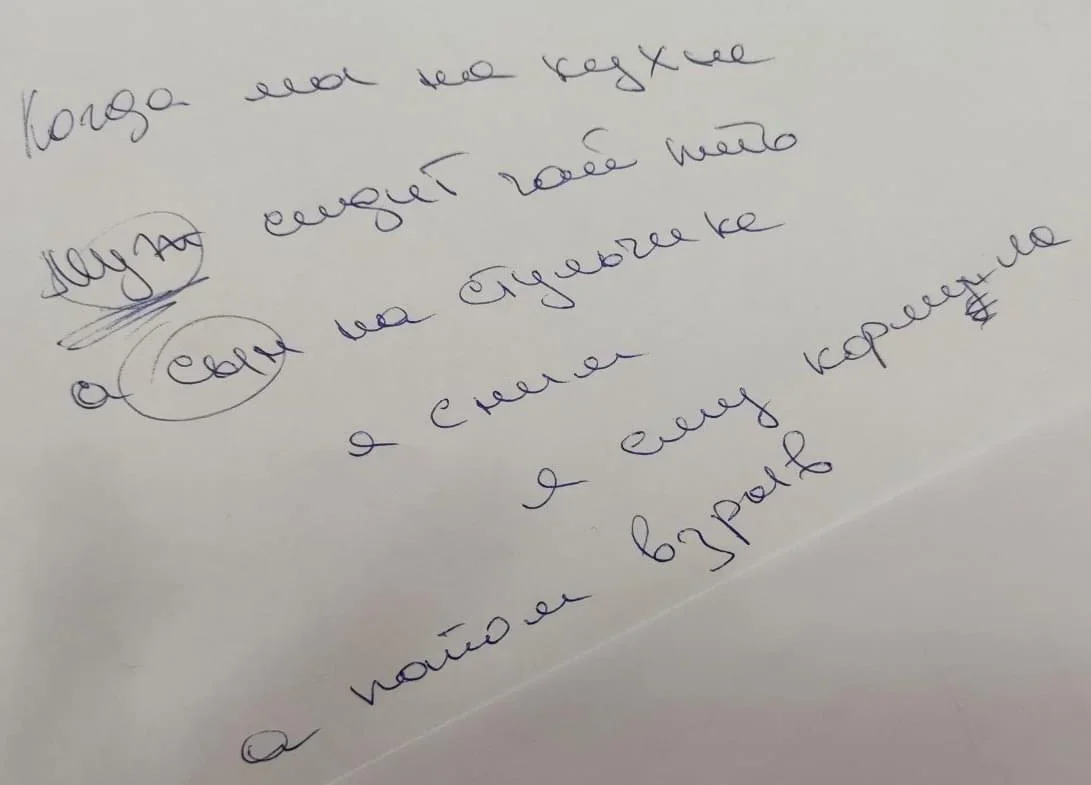
On 14 January 2023, a Russian Kh-22 missile struck a nine-storey residential building in the central Ukrainian city of Dnipro, killing 46 people, including six children. Katya, the last survivor to have been retrieved from under the rubble nearly 24 hours after the strike, later wrote down what she remembered while in the ICU.“We were in the kitchen. My husband was drinking tea, and my son was in the high chair. I was with him, feeding him. Then there was an explosion.” Neither her husband Olexiy nor her son Mykyta survived.
Rescue workers remove rubble from the site of the damaged residential building in Dnipro struck by a Russian missile, 15 January 2023. Photo: EPA-EFE/OLEG PETRASYUK
DAY 387: Putin indicted by ICC for war crimes
On 17 March 2023, the International Criminal Court issued an arrest warrant for Vladimir Putin and Russian Children’s Rights Commissioner Maria Lvova-Belova, accusing them of war crimes committed during Russia’s invasion of Ukraine, namely the unlawful deportation of Ukrainian children to Russia. While the immediate impact within Russia has been minimal, given the Kremlin’s dismissal of the charges as politically motivated, the warrant signified a step towards Putin’s further isolation from the international community, as signatories to the Rome Statute were now obliged to arrest him.
A man poses for a picture in front of a poster depicting Vladimir Putin being brought as a prisoner before the International Court in The Hague by Ukrainian General Valery Zaluzhnyi, in Kyiv, 9 May 2023. Photo: EPA-EFE/OLEG PETRASYUK
DAY 452: The fall of Bakhmut
On 21 May 2023, the Russian Defence Ministry announced the capture of Bakhmut, a city in eastern Ukraine’s Donetsk region with a pre-war population of 70,000 that has been almost completely destroyed during months of fighting. During a visit to Japan the same month to attend the G7 summit, Volodymyr Zelensky said of his visit to the Hiroshima atomic bomb museum that while it “wouldn’t be fair” to compare the events in Hiroshima to what was happening in Ukraine, the pictures of the ruined city reminded him of Bakhmut. “Nothing alive is left,” Zelensky said.
An aerial view of Bakhmut in June 2023. Photo: Yan Dobronosov/Global Images Ukraine/Getty Images
DAY 468: Kakhovka dam collapses
The Kakhovka dam, built on the Dnipro River in southern Ukraine, collapsed in the early hours of 6 June 2023, leaving thousands of Kherson residents without homes and devastating the region’s natural life. The true scale of the destruction remains unknown, as much of the flooded area remains under Russian occupation. “It terrifies me to think of the old people who lost their lives; very few were rescued. We don’t know how many of them drowned. I don’t know if we ever find that out,” Natalia, a resident of Hola Prystan, a town on the left bank of the Dnipro occupied by Russia, told Novaya Europe in July 2023.
A man stands and his roof with his dog as the floodwaters from the collapse of the Kakhovka dam continue to rise in Ukraine’s Kherson region, 9 June 2023. Photo: EPA-EFE/MYKOLA TYMCHENKO
DAY 573: Zelensky addresses UN in person
On 19 September 2023, Volodymyr Zelensky addressed the UN General Assembly in New York in person for the first time since the start of Russia’s full-scale invasion of Ukraine, urging global leaders to unify in the fight against Kremlin aggression. “Many seats in the General Assembly Hall may become empty if Russia succeeds with its treachery and aggression,” Zelensky warned.
Zelensky speaks during the 78th session of the United Nations General Assembly in New York, 19 September 2023. Photo: EPA-EFE/JUSTIN LANE
DAY 675: Russians first feel impact of war
On 30 December 2023, shelling in the centre of Belgorod, the closest Russian city to the Ukrainian border, killed 25 people and wounded over 100 others, making it the most deadly Ukrainian strike on a Russian city since the beginning of the war.
The aftermath of the Ukrainian shelling of the Russian city of Belgorod. Photo: Vyacheslav Gladkov / Telegram
DAY 807: Russia begins Kharkiv offensive
On 10 May 2024, Russian troops launched a fresh offensive on Ukraine’s Kharkiv, first dropped aerial bombs in the area of Vovchansk, and then attempting to break through Ukrainian defensive lines in armoured vehicles. While it did manage to retake some border areas, Ukraine’s second city Kharkiv was never seriously under threat and despite modest gains, it didn’t significantly alter the increasingly stalemated war.
A man sits outside his home as clouds of smoke rise in the distance above Ukraine’s Kharkiv region following the start of the Russian offensive. Photo: EPA-EFE/GEORGE IVANCHENKO
DAY 843: First Ukraine peace summit held
On 15 June 2024, a two-day Summit on Peace in Ukraine began near Lucerne in Switzerland, where delegates hoped to map out a peace plan for Ukraine despite the absence of both Russia and China from the proceedings. While delegations from 92 states attended the summit, including the national leaders of some 57 countries, relatively little progress was made, with several countries declining to sign the final communiqué.
Ukrainian President Volodymyr Zelensky during the Summit on Peace in Ukraine in Stansstad, Switzerland, 15 June 2024. Photo: EPA-EFE/ALESSANDRO DELLA VALLE
DAY 866: Airstrike on Kyiv children’s hospital
Russia’s massive missile attack on Ukrainian cities on 8 July 2024 killed over 40 civilians, with 33 innocent lives lost in Kyiv alone. Ukraine’s largest children’s hospital, Okhmatdyt, was one of the targets of the attack. “A missile struck a two-storey building in the central part of the hospital, where young patients were receiving dialysis. The shock wave blew out windows and doors, covering both the cancer ward and the intensive care unit with glass,” Novaya Europe’s correspondent Olga Musafirova reported at the time.
First responders at the site of a missile strike on the Okhmadyt Children's Hospital in Kyiv, Ukraine, 8 July 2024. Photo: EPA-EFE/SERGEY DOLZHENKO
DAY 895: Ukrainian forces cross into Russia
Despite being increasingly pinned down in Donbas by the creep of the Russian military’s slow but inexorable advance, on 6 August 2024 the Armed Forces of Ukraine launched an audacious cross-border assault from the country’s northeastern Sumy region into Russia’s Kursk region, taking Russian border guards by surprise, and stunning the world. Marking the first invasion of Russian territory since World War II, the Kursk incursion has since become a small-scale occupation that still hasn’t been brought to an end by Russian forces more than three months later.
A young evacuee looks out of a railway carriage at the main train station in Kursk following a surprise Ukrainian incursion into Russian territory on 6 August 2024. Photo: EPA-EFE
DAY 924: Mother and three daughters die in Lviv strike
Yevhenya Bazylevych, 43, and her three daughters, Yaryna, 21, Daryna, 18, and Emilia, 7, were killed in Russian shelling of the western Ukrainian city of Lviv on 4 September 2024. Father and husband Yaroslav Bazylevych was seriously injured in the attack, but survived to bury them all two days later. Seven people died in total, with another 35 injured.
People attend the funeral of a mother and her three daughters who were killed in a Russian missile strike on Lviv, in western Ukraine, 6 September 2024. Photo: EPA-EFE/MYKOLA TYS
DAY 998: Russia launches fresh strikes on Ukrainian infrastructure
On 17 November 2024, Russian forces showered cities across Ukraine with some 120 missiles and some 90 drones in an attempt to further compromise the country’s energy infrastructure as winter draws in. The Russian Defence Ministry said that it had targeted “critical energy infrastructure facilities” that “ensured the operation” of Ukraine’s military enterprises, adding that “all planned targets were hit”.
A Ukrainian woman in the aftermath of a Russian airstrike on the port of Odesa in southwestern Ukraine, 17 November 2024. Photo: EPA-EFE/STATE EMERGENCY SERVICE OF UKRAINE